

003. Buying secondhand firsthand
Discovering the wonders of consignment and falling in love with preloved.

I’m about to reveal something I’m a little ashamed to admit.
Before this year, I had never gone thrifting.
Don’t get me wrong — I’ve used tons of hand-me-down clothing and household items that I’ve gotten directly from friends and family over the years, but until recently, I had never expressly sought to purchase secondhand items (except for maybe my used cars).
For many years now, I have been what I’d describe as a conscious consumer. I buy products that have sustainability certifications; I seek out sustainable brands (I even worked on the Amazon Private Brands sustainability team, helping to make the Amazon Basics and Amazon Essentials brands more sustainable); I drive a hybrid car; I am a discerning reader of labels and ingredients; I bring my reusable tote bags to the grocery store; I default to buying organic produce; and I generally try to do less harm for the planet. But even as a sustainability-minded person, somehow buying secondhand items was never really part of my repertoire.
Let me first say that I think it’s a really positive sign that I felt ashamed to admit that — it means that the cultural tide, along with any former stigma that may have existed about secondhand shopping, is starting to turn. Thanks to Gen Z and to a large extent, social media, a growing number of people now proudly document their latest finds from thrift stores or resale platforms. It’s even becoming more common to see in traditional media, like featuring a main character who loves thrifting in the latest Christmas movie, “A Merry Little Ex-Mas” on Netflix.
Of course, plenty of people still proudly promote their fast fashion hauls from Shein and Temu…so we have a ways to go! But overall, secondhand has gone mainstream in a big way, and it’s here to stay.
According to the 2025 ThredUp Resale Report, which has captured trends in the resale market since 2019, the U.S. secondhand apparel market is expected to reach $74 billion by 2029, growing 9% annually on average. In 2024 — which saw the strongest annual growth since 2021 — it grew 14%: 5X faster than the broader retail clothing market.
Two other eye-popping stats jumped out at me from the report:
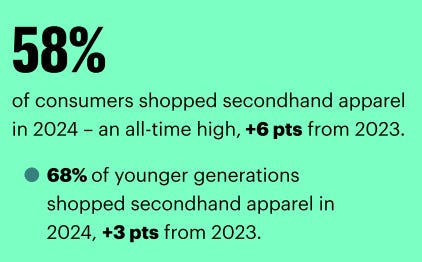
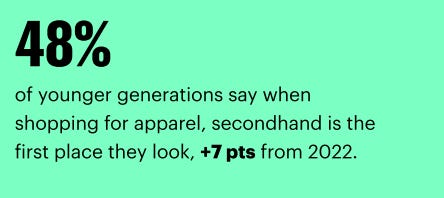
Source: 2025 ThredUp Resale Report
Apparently a LOT of people in my generation and younger are already participating in this revolution. Clearly I have been missing out. 🤦🏼♀️ And as a budding circular economist, I clearly needed to try it for myself.
As it turns out, the first opportunity to try it firsthand fell into my lap in a fairly serendipitous way.
When I pitched my idea for the Swap Event to the head of my kids’ school (read my last post on that topic if you haven’t already!), she told me the idea reminded her of Rhea Lana’s. To be perfectly honest, my first question was, “What is Rhea Lana’s?!” I had never heard of it, but it seemed like it would be right up my alley if it was being compared to the Swap.
She said it was a pop-up kids and baby consignment event that happens twice a year, and that everyone who knows about it gets really excited for it. Sure enough, I looked it up immediately after we talked, and there was one too not far from me that had an event coming up a few weeks later.
I was still new to the world of consignment at that time, so if there are any others in that same boat, let me quickly explain the concept. Consignment is a process whereby a seller entrusts a third party retailer to sell an item on their behalf. The seller (called the consignor) only gets paid if and when their item is sold. The retailer retains a fee or takes a cut of the sale in exchange for providing the selling platform. In the case of Rhea Lana’s, if an item doesn’t sell, the consignor can choose to take the item back or opt to donate it to a local charity.
For Rhea Lana’s or other consignment shops to function, they need a two-sided pipeline: consignors to sell their items and shoppers to buy them. I decided to take on both roles (as the overachiever that I am) to see what the experience was like from each side.
My Experience as a Consignor
As a first-timer, I started by spending a lot of time on my local Rhea Lana’s website reviewing guidelines and watching tutorials on how to consign and prep my items. I generally found the process to be pretty user friendly — that being said, it will be SO much easier my second time around now that I have the hang of it.
Here is a rundown of the 5 main steps in the process:
👕 Decide what you want to consign. Rhea Lana’s, like all consignment shops, has guidelines around what they will accept (e.g., certain brands, gently used but great condition, nothing that has been recalled, etc.), so start by going through your stuff and making a pile of items that meet the criteria.
💻 Enter your items into the database. Once you know what you’re consigning, you enter each item into an online database with information like size, item type, brand and price. I found this part to be the most tedious because I had to set my own prices. They do have a suggested ballpark percent of full retail that your item should be (depending on brand), but it’s still quite manual to look up full retail prices and estimate your own price. I think this step could be better automated by AI in the future, but overall it was pretty straightforward.
🏷️ Get your barcodes. All the items need to have barcodes for checkout. Once everything has been entered into the database, you can generate and print the barcodes yourself or pick them up at your local Rhea Lana’s in advance of the sale.
🧷 Hang and/or label your items. Next is getting the supplies for hanging and labeling the items. In this case, I needed safety pins, labels (for the barcodes), masking tape and kids’ hangers. Again, lots of easy tutorials for how to put the barcode on the label and how to hang the items in their specific way. They also recommend doing whatever you can to make the items look their most presentable (e.g., ironing, bundling matching tops and bottoms, etc.). The better you present the items, the more likely they are to sell, so it’s worth it to put in the effort. It’s easy, but it just takes a lot of time and care!
👋🏻 Drop your items off! This was the easiest part of my Rhea Lana’s experience. I opted for the curbside drop off option, and a few people came up to my trunk and unloaded everything super efficiently for me. I just signed some paperwork, and off I went! The whole thing took less than 3 minutes.
Summary and Reflections:
In the spirit of full transparency, I ended up earning about $150 (I tried to look up the number of items I sold, but I can’t access the database anymore - I believe it was something like 28 out of 37 items). Many people can make much more than that by selling higher-ticket items. For context, I mainly focused on clothing and some smaller baby gear this time around.
Looking back on it, one of my favorite things about consigning with Rhea Lana’s was the deadline aspect of it. There were certain dates you had to hit for your stuff to be included in the sale (and it only happens twice a year), so that was really good motivation to power through some of the more tedious and time consuming steps in the process. For some reason, if someone told me I could drop off my stuff at any point in the year, I probably would have more difficulty finding the time to do it! #busymomlife.
I also loved during the actual sale that I could see in real time on the portal which of my items had sold — it was a fun little distraction and game to guess which item would sell next!
It was a great experience, and I can’t wait to do it again next season. Good thing I’ve already got all my leftover safety pins and tags ready to go! (Says the girl who had never tried it before and now feels like a pro).
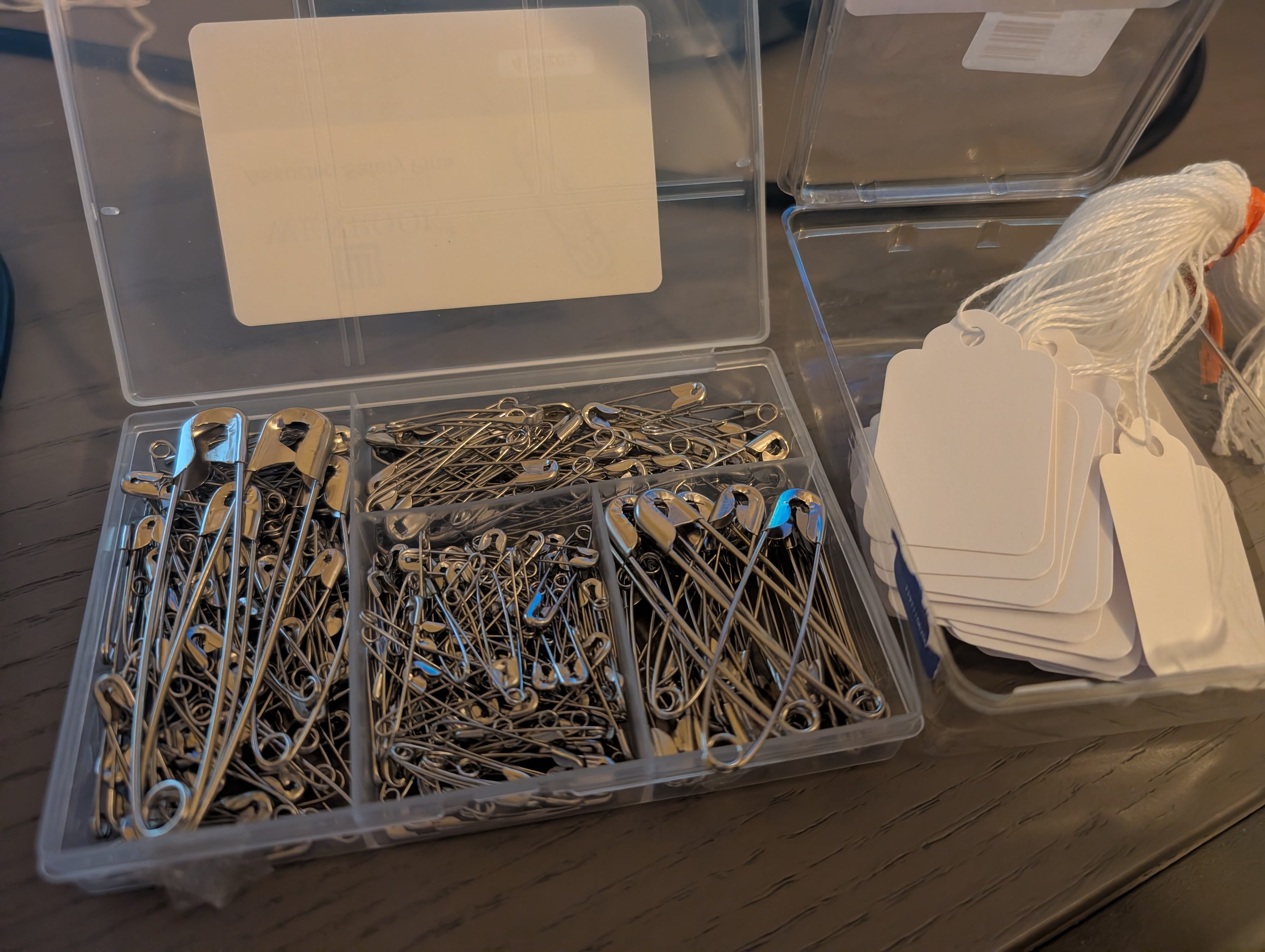
Have you ever seen so many sizes of safety pins in your life?!
My Experience as a Shopper
One of the other great things about being a consignor at Rhea Lana’s is that you get early access to shop the event! The sale to the general public lasts about a week, but consignors get in a couple days early, which I thought was a cool perk.
I didn’t know quite what to expect, but I went in hoping to discover some good finds at a great value. Going through the consignment side made me realize how good of a deal people were getting on my stuff, so I was optimistic that I’d find similar gems from others (spoiler: I did).
Funny enough, I actually went in hoping to buy some books, but I came out with $97 worth of clothes and not a book in sight. 😂 As an aside, my gripe with the books is that so many of them were in gallon-sized Ziploc bags with 4-5 bundled books in one bag. A lot of times there would be only one book in the set that I’d actually want, so I didn’t want to buy the whole set. But that was truly the only disappointing thing about the experience.
I ended up getting several winter coats, some ridiculously cute tutus, some holiday outfits (including matching dresses in two different sizes - score!) and some adorable top and bottom sets. Most notably, I was able to find lots of brands that I already buy and trust, but at a fraction of the price (for example, I got a kids’ Patagonia jacket for $15, which retails brand new for $89). Some other items I got even had tags still on! I felt smart (but also stupid for not doing this sooner), and I felt like I had won the jackpot.
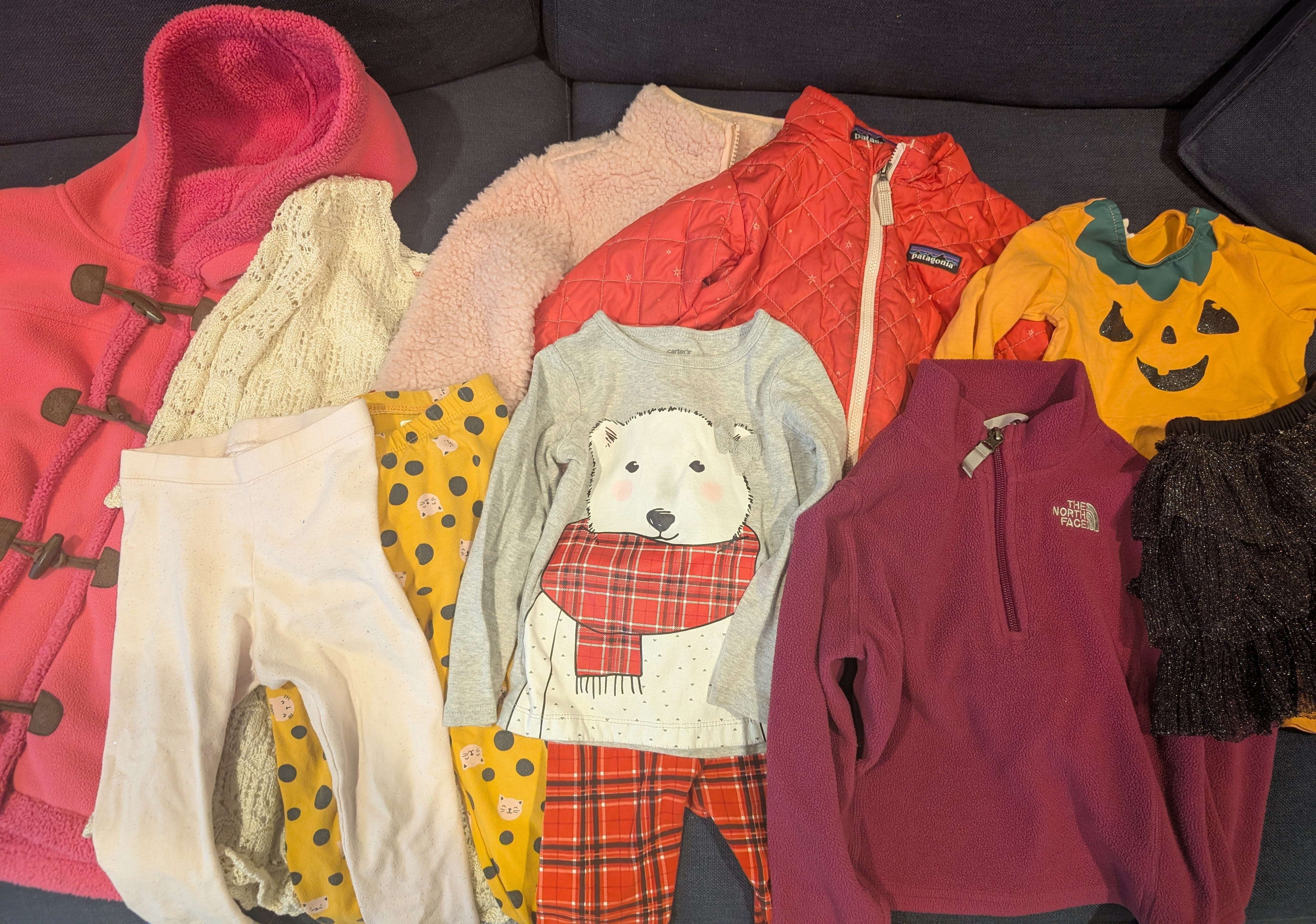
Part of my haul! Hanna Andersson, Patagonia, North Face and Carters were among the great brands I found.
Other takeaways
🧸 It was definitely interesting to see lots of the same item (e.g., toys) with different prices — which gave me a taste for the thrill of the hunt (which one is the cheapest?!), as well as intel that maybe I had priced certain items too high!
🧐 I also loved the in-person nature of Rhea Lana’s — as someone who does the vast majority of my shopping online, it was refreshing to go and look at things in person. In all honesty, I also found this especially helpful for secondhand, so I could take a closer peek at the condition and material tags/care instructions.
👩🏽🎓 I also really appreciate that Rhea Lana’s goes all the way through teenage years, because I plan to keep consigning and shopping as long as I have stuff to give (and buy) — which is always, for the next decade plus.
I hope this post inspires you to check out consignment shops in your area (Rhea Lana’s or otherwise). You can find all the Rhea Lana’s locations on their website. I am not getting paid to promote this, by the way — I just loved it and wanted to share.
If you’re an experienced secondhand shopper, let me know your favorite place to shop in the comments below!