

009. More/Less List for 2026
A more intentional approach to making my goals stick year-round.

Ah, early January.
That special time when we sneak into the pantry to finish *one last piece* of chocolate when no one is looking.
When the car music switches from “Rudolph” back to the Moana soundtrack on repeat (ok, maybe this is just my car…).
When we flip our crisp new day planners to the first, blank page.
And when we finally have a moment to pause and think about our resolutions for the new year ahead. ✨
Personally, I’ve always loved the act of making resolutions.
I view them as an act of hope — that future me will be better off than current me. That all the good habits I’ve dreamed about for a while will finally start to solidify.
But in the words of Jeff Bezos: “Hope is not a plan”.
(As a former Amazonian, I’ve heard this phrase more times than I can count).
In fact, according to Forbes, a whopping 80% of people ditch their New Year’s resolutions by February — and further research shows only 9% actually go on to complete them (Batts 2023).
You might be tempted to look at those statistics and say, “why bother setting resolutions at all? I’ll probably fail anyway.”
Or, like me, you could ask — What are those 9% of people doing that I’m not?
Maybe I’ve just been leaning too hard into the hope, and not enough into the plan.
What kind of magic could happen if I actually tried to set myself up to succeed for the long haul?
My Approach in 2025
Last year, I did tweak my approach a bit from previous years. But not quite in the way I needed to.
Let me explain.
In January 2025, I discovered something called a More/Less List, which was first created in 2017 by an author named Julia Rothman.
I loved the idea behind it: to set overall intentions for the year instead of creating traditional resolutions (you know your Intentionalista loves a good intention). In the words on the back of Rothman’s newly released More/Less journal, it’s meant to be a “fresh, no-pressure approach to goal setting.”
It also seemed fun — and super easy.
So I tried it!
Here is my actual More/Less List from 2025:
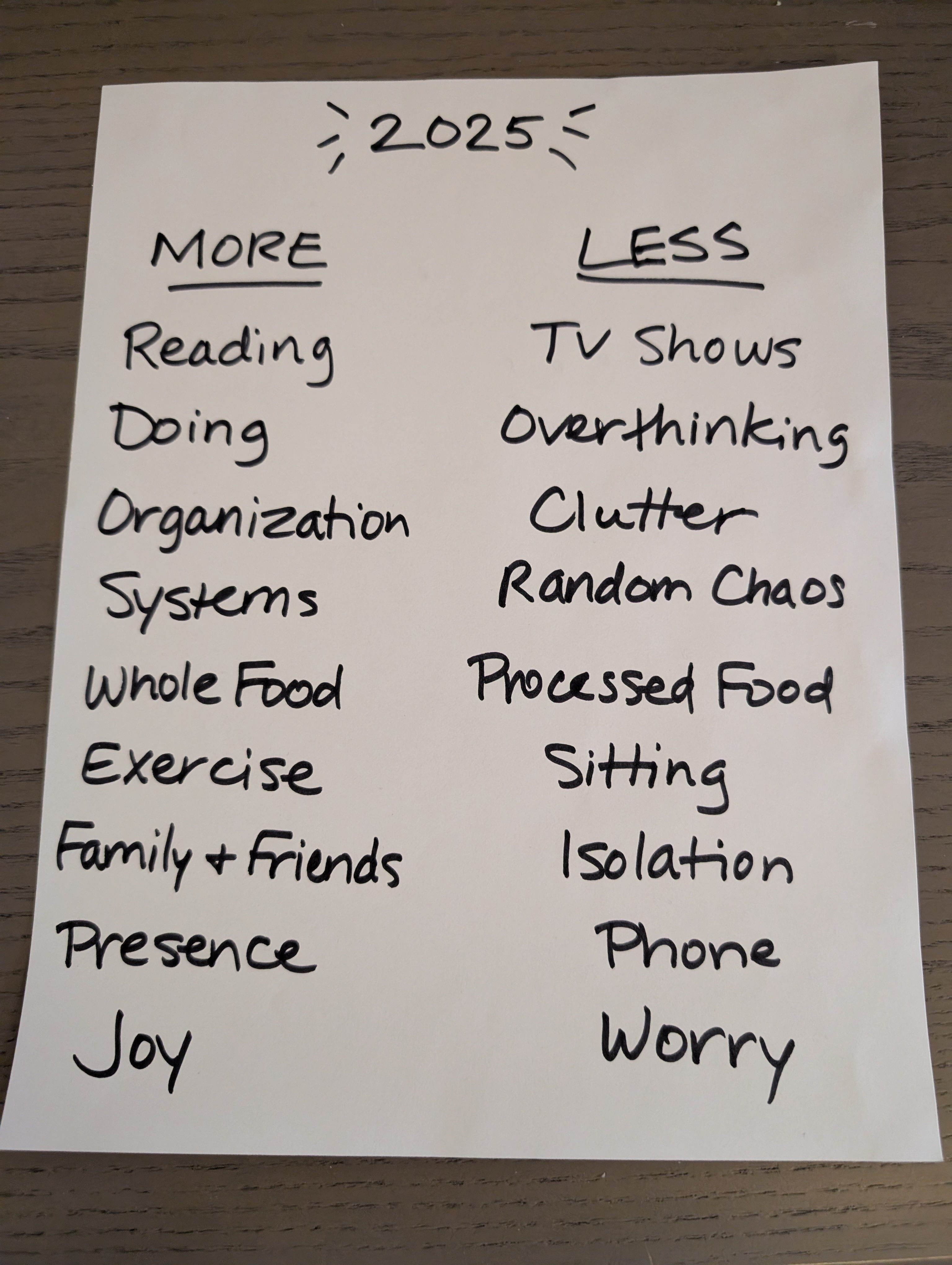
I displayed this list on my desk in my office all year and would often give it a knowing nod after staring at it for a minute or two. Like, “ah, yes. Good reminder.”
But in looking back at this list a year later, it’s hard to tell if I was truly successful.
Some things were definitive — for example, “doing” over “overthinking”. I left my corporate job with nothing lined up. I started this blog (and I haven’t missed a week of posting since I started 8 weeks ago). I organized the first-ever Swap Event at my kids’ school. I finally toured my local MRF after thinking about doing it for a long time. I started posting regularly on LinkedIn. That feels like lots of doing and way less overthinking to me.
But then there were some tricky ones, like “joy” vs. “worry”. What exactly did I mean when I wrote that? I’m not entirely sure. I know there were *countless* moments of joy over the past year — and I was certainly more intentional about being present with my kids and soaking in all the childhood joys.
But I still did my fair share of worrying too. Have you seen the state of the world lately? I’d be worried if you weren’t worried. I did make a conscious effort to remove news alerts from my phone, and I almost never go on Facebook anymore. But I’d still call this one a toss up.
While I made some good progress in the right direction, I was still left with doubt as to how much.
Was I actually training myself to be objectively better at some of these things, or was I pretty much the same, save for a few minor victories here and there?
To be clear, there wasn’t anything wrong with the exercise itself. Or any type of resolution exercise for that matter.
It was the way I had gone about it — as if simply writing down my intentions would trigger the magical hope fairies to sprinkle some pixie dust and transform my life for the better.

I thought about how, if someone had shown me this list in a work setting and said, “Here are the things I am going to accomplish this year,” I would probably raise one eyebrow. And have some questions.
How are you defining some of these terms?
What is your success criteria?
Why did you choose these particular areas to focus on?
How are you quantifying “more” and “less”?
What is your accountability mechanism?
In other words, I would say “this is a good start, but come back to me with an actual plan”.
Why shouldn’t I hold myself to the same high standard I would have for a coworker?
My Approach in 2026
A few days ago, I did this exercise again to kick off 2026. Only this time, I tweaked my approach (again).
Here’s my new list:
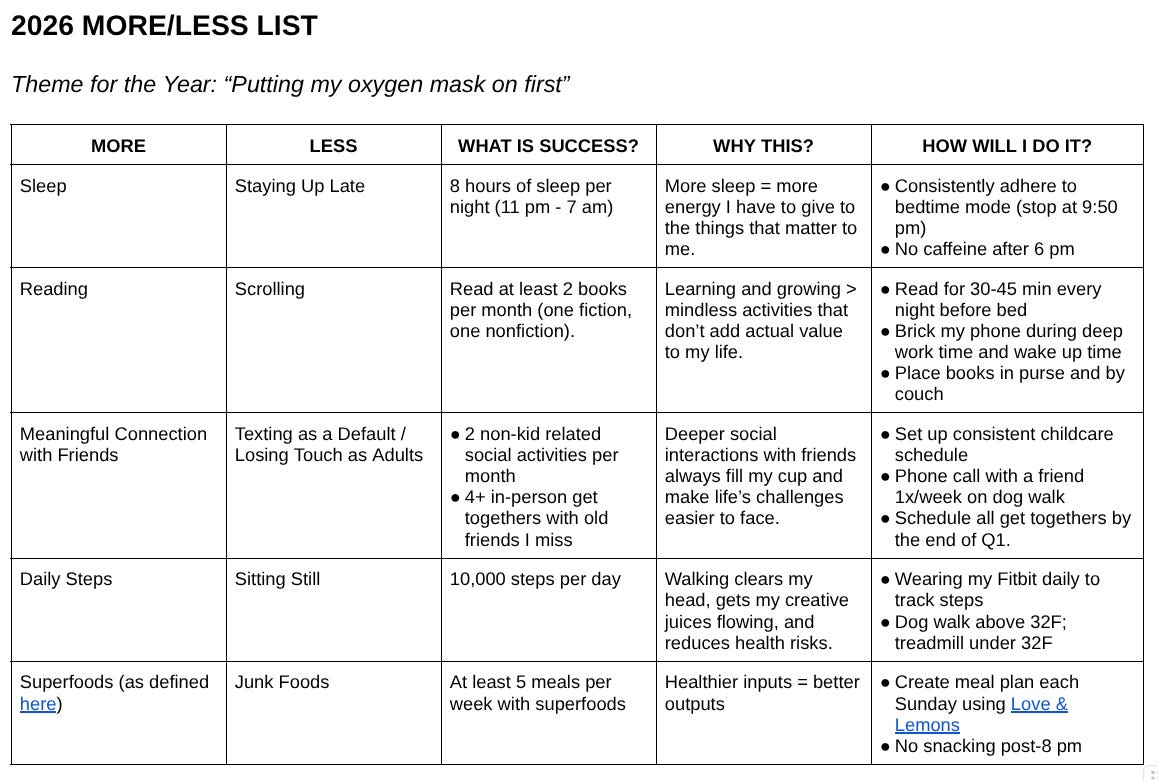
For any readers who are already really good at some of the things on my list, you might look at this and think “gosh, these are the basics". And you’d be right. For too many years in a row, I haven’t been great at the basics (the pandemic and two kids are partly to blame, ahem). But I’m here on this journey in earnest, because I don’t want another year of wishing and hoping to pass me by.
And if you see yourself in this list, I see you right back. You are not alone, my friend.
Breaking Down the Takeaways
If you’d like to try making your own More/Less list this year, I put together the following takeaways (using my own lessons learned) to help guide you through the process.
✅ Make it measurable. Words like “joy” and “worry” are much harder to quantify and define than something like “daily steps” and “reading books”. What does “more” actually look like on a daily or weekly basis? Let success be objective, not subjective.
✅ Scale back to the most critical. Last year’s list had nine rows. This year’s has five. As you create yours, think about which ones are most important. In other words, which ones will have the biggest asymmetric effect on your life if you get them right?
✅ Make your “why” matter. Ask yourself, am I just setting this goal because it’s January and I know I should set new goals? Or am I trying to ingrain healthy habits so I live a long life and don’t miss any of my kids’ big moments? Meaningful alignment to a bigger “why” is what will keep the motivation alive.
✅ Create an accountability mechanism. Don’t wait until December 31 to revisit the promises you made to your future self. Set checkpoints to review your progress (and make any pivots) at regular intervals throughout the year. This year, my husband and I are doing monthly check-ins on the last day of each month, as well as quarterly reviews (just like I would evaluate that imaginary “coworker” I wanted more details from…).
✅ Create systems that support the “how”. In my list, I reference things like “bedtime mode”, “Bricking” my phone, and wearing a Fitbit. These are mini systems I’ve set up to automatically reinforce a desired behavior. Systems are the difference between setting intentions in January and being intentional year-round. Pair systems with an accountability mechanism, and magic starts to happen (no pixie dust required).
✅ Keep it simple. Notice how I didn’t include anything professional on my list? I could certainly do a whole separate list for work or other aspects of my life. But in my view, keeping it simple (just focusing on YOU) will naturally translate into improvements in other parts of your life.
✅ Come up with a theme word or phrase that connects all of your goals. My theme this year is “Putting my oxygen mask on first”. Now that my kids are out of the baby stage, I want to focus on reclaiming (some of) my time and renewing my sense of self. Think of your theme as a one-liner that can immediately snap you into focus and serve as a reminder of what you want to achieve. It’s also something my husband can say to me if I’m ever veering off course. Like a secret code. Shhh.
✅ Always Be Tweaking (ABT). This is a totally made up acronym, but I love it. Just because something didn’t serve you perfectly last year, doesn’t mean you need to abandon it completely. Tweak it for your needs. There are so many different goal setting techniques out there — just keep experimenting to find the one that works for you. And once you find one, keep tweaking to refine it further once you learn what’s missing.
Oh, and one last thing: You’ve got this. 🙌🏻
To being more intentional (not just setting intentions) in 2026,
Jenny
PS: In case you missed last week’s post…
A quick note on what to expect from this blog in 2026:
As we begin the new year, I will be mixing in more intentional human content like this, in addition to my intentional consumer content of late.
I purposefully named this blog The Intentionalista to cover a range of topics under the “intentional living” umbrella (read my first blog post about that here).
So while you can expect to see *a lot* more posts sharing actionable, informative and inspirational nuggets of wisdom about the circular economy, you’ll also see more posts about being intentional in one’s life and career, setting personal goals, and creating systems to achieve them. All through the lens of my own transparent, down-to-earth (and hopefully entertaining) learning journey on the path to personal growth in both of these areas.
You can think of it as reducing “waste”, holistically: reducing physical waste by being more intentional about how we consume (and how we design things better from the start), and reducing time waste by being more intentional about how we live and work.
I’m so excited to have you along for the ride. Let me know what you think in the comments!
Some have asked about the links embedded in the screenshot of my 2026 More/Less list. Providing them here for reference!
Superfoods: https://www.health.harvard.edu/blog/10-superfoods-to-boost-a-healthy-diet-2018082914463#:~:text=However%2C%20there%20are%20a%20few,Week%20Plan%20for%20Healthy%20Eating
Love & Lemons: https://www.loveandlemons.com/