

011. Being a steward, not just an owner
What a Craigslist gem taught me about stewardship of everyday items

A few weeks ago, I met a perfect stranger in a Walgreens parking lot.
I brought cash. He brought “the goods”.
As soon as we both confirmed we were the one, the stranger’s trunk hissed open, revealing what I’d been anticipating for the previous 24 hours.
It wasn’t a Top Secret silver briefcase or a sketchy manila envelope (sorry to disappoint).
It was a 5 foot tall Frozen castle.
The kind stranger introduced himself. He was a dad of two girls, 11 and 8, who had outgrown the castle but had loved playing with it for the past three years.
Only you could barely even tell they had used it.
Only one original piece was missing (and it was not something critical or even noticeable), and everything else was in immaculate, working condition.
It was clear their family had taken great care of it.
When I told him my two young daughters would be ecstatic to have it, he smiled warmly and started reminiscing about giving it to his own girls.
“It took me forever to build this thing,” he said fondly. “I still remember the effort it took to put on all the little stickers just right.”
“Thanks for doing the hard part for me!” I laughed. “We’re going to cherish it.”
I handed him the cash and we parted ways, vanishing back into stranger status once again.
Craigslist transaction complete.
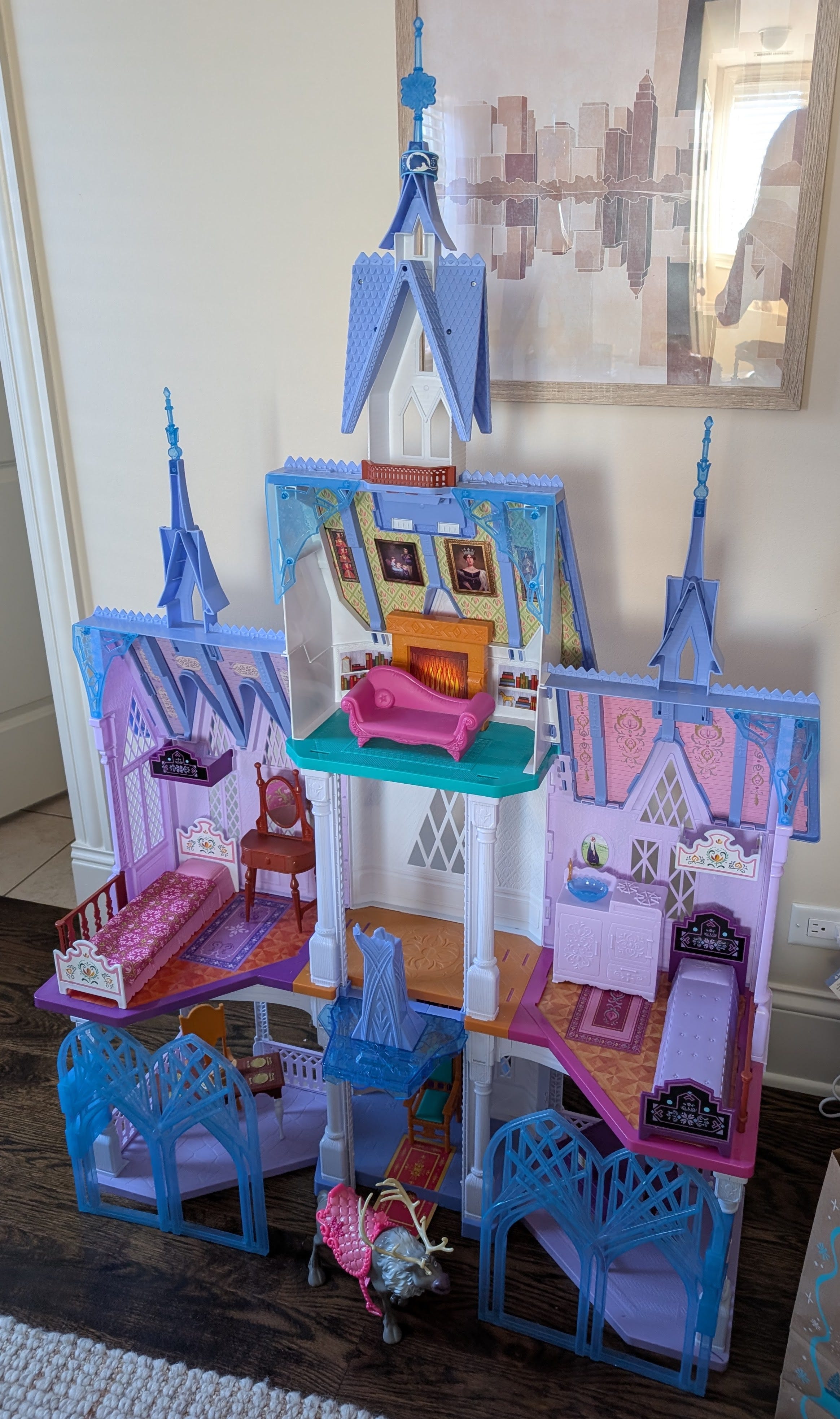
As I drove home — still basking in the glow of my amazing find ($80 vs. $300+ retail) — I kept thinking about why a Craigslist pickup from a random stranger had oddly felt so special.
I realized it was because I wasn’t just handed a toy — I was handed someone’s memories.
And in a weird way, I felt a strong sense of obligation to make sure I took care of it in the same way that family had. In fact, I could easily envision myself back in a similar Walgreens parking lot four years from now, handing it off to another beaming parent excited to gift it to their daughter.
This simple, 5 minute experience made me reflect on a concept that is critical to the circular economy: item stewardship.
It means taking care of what you have so it lasts as long as possible, rather than treating things as trash-in-waiting. It comes with the understanding that the longer our existing resources stay in use, the fewer new resources we need to extract from the planet.
While anyone can be an owner of an item, it takes some conscious effort to be a steward.
Stewards realize that they don’t really “own” anything at all; rather, they are temporary guardians of items in their care.
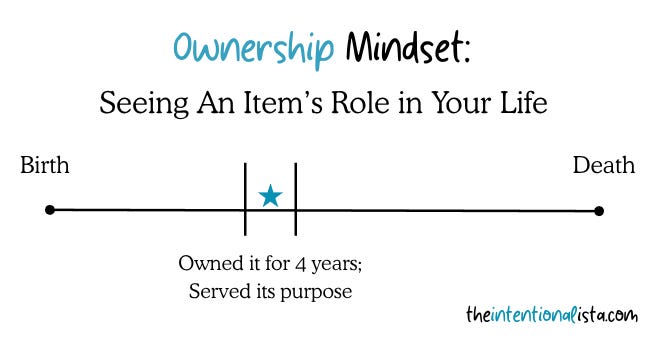
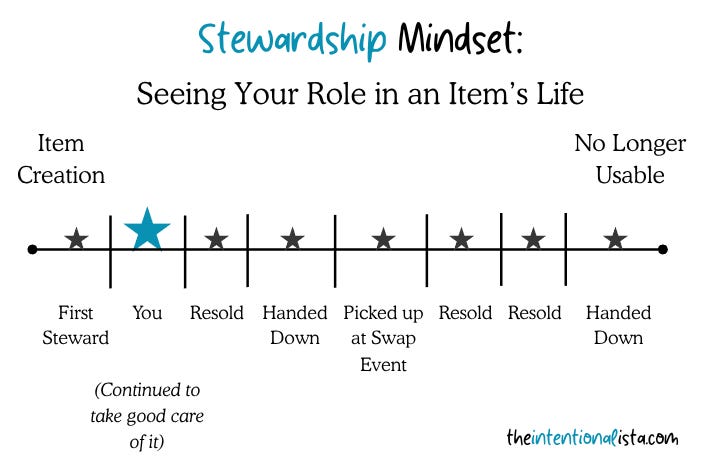
To illustrate the difference between ownership and stewardship, take a look at the two images below.
Someone with a purely ownership mindset thinks of items as being useful to them in the context of their own life. They don’t necessarily give much thought to what will happen with the item when they’re done with it.
In contrast, someone with a stewardship mindset acknowledges that their usage is just one chapter of an item’s story, not the beginning nor the end. They recognize their responsibility to start, or in my case with the castle, continue the chain of care-taking so it lasts beyond their needs.
That father and his little girls had been excellent stewards of the Frozen castle. I mean, not even *one* little sticker was ripped off! A true feat.
Because of that, this beautiful (and humongous) castle is now going to get another life with our family — and hopefully many more lives after that.
Now, before you think I’ve gone all woo woo over a Frozen castle (has she officially lost her mind?! Last week she went gaga over a waffle maker, and now a plastic toy?), just think of all the ways you regularly experience this concept in your own life.
🏠 The house you bought: Do you keep up the landscaping? Maintain your appliances? Make sure the roof is in good shape?
🚗 The car you drive: Do you take it in for regular maintenance? Make sure not to bang up the doors on the garage wall?
💎 The heirloom jewelry your grandmother gave you: Do you keep it in its nice velvet storage box? Make sure it’s not tangled up with other jewelry?
How about things you “own” for a very short while:
🛋️ The Airbnb you rent: Do you put everything back how you found it? Do you tidy up your messes and make sure not to spill anything on the couch?
📷 The fancy DSLR camera you borrowed from your friend: Do you handle it with care? Do you keep it in its case when you’re not using it?
If you answered “yes” to any or all of these questions, you already know how to be a steward, not just an owner — and I’ll bet you do many of these things instinctively (even without the threat of a bad review on Airbnb).
That’s because there’s a tacit understanding that these things have long-term value.
And that they won’t be ours forever.
We invest in them and keep them maintained so we can extend their life, or even resell or hand them down for someone else to enjoy.
But while it’s expected (and there are obvious benefits) for people to be stewards for the expensive stuff, the real challenge — and mindset shift therein — is to become a better steward for everyday things. Your kids’ toys. Your clothes. Your pots and pans. Things you might have a shorter-term attachment to, but that still have enormous long-term value.
However, I have great news 💥:
What’s been true all along for expensive item stewardship is also true for everyday item stewardship: the better we maintain these items, the higher resale value we expect to see. And the higher quality materials the items are made from, the longer we can expect them to stay in circulation.
This also means you don’t have to share my sappiness or feel compelled to take better care of regular, everyday objects out of the goodness of your heart.
It means there’s still something in it for you.
Benefits of Item Stewardship
Here’s a quick breakdown of the benefits of item stewardship, along with some simple ways I’ve been retraining my brain to think the exact same way about an $80 Frozen castle as I would for a $40,000 car.
1️⃣ Item Longevity. Taking good care of everyday items means it’ll be longer before you need to spend money to replace them. Just like your trusty Honda can last 200k-300k miles with regular maintenance, your kitchen gear, clothing and kids’ toys can last a long while too — especially if you buy good quality ones that you properly look after.
Retrain your brain: Buy (new or secondhand) items with longevity in mind from the beginning.
Seek out durable, higher quality materials (just like you wouldn’t buy a house made of straw 🐷)
Follow the care instructions (just like you’d follow your car’s recommended maintenance schedule)
Repair or mend items instead defaulting to replacement whenever there’s a cost-effective, fixable flaw (you wouldn’t buy a whole new car just because of a flat tire, would you?)
Support brands that pride themselves on quality craftsmanship (Hondas last a long time for a reason). Sidenote: I recently became aware of an awesome website called BuyMeOnce, which features brands and products that are built to last. It’s not super robust yet for the US, but the UK version is a gold mine of trustworthy brands and products.
2️⃣ Resale Value. Quality, everyday items that are well maintained can often retain their value too. With the explosion of resale platforms in recent years, there are opportunities everywhere to recoup a good chunk of your initial investment and keep items in circulation longer. Not to mention, if you know someone else is going to use it after you, you are more likely to take better care of it — if for no other reason than cashing in at the highest price.
Retrain your brain:
Consider an everyday item’s resale potential before the point of purchase (just like you would consider important factors for resale when buying a house)
Store your items properly when you’re not using them to protect their value (just like you would keep a designer purse in its dustbag)
Keep the original box (if it makes sense to do so) and keep all the parts organized (though remember it doesn’t need to be in perfect condition to still have tons of value — my husband just sold a bunch of video games from the ‘90s for $400!)
3️⃣ Legacy. There are even some cases when taking care of your everyday items means you can pass them down to your kids one day. I’m not talking junky old gadgets from your garage. I’m talking dishware, high quality pots and pans, decorative items that will stand the test of time, and other durable home furnishings that your kids would not be embarrased by when their friends come over. It’s a form of quiet philanthropy that keeps giving over time.
Retrain your brain:
Buy items you know you will cherish (just like you connect to the beauty and craftsmanship of your grandmother’s heirloom jewelry)
Opt for timeless, always-useful items (just like a Rolex that never goes out of style)
Share stories and memories with your kids about where and why you bought the item in the first place (or better yet, let them be part of the story)
To cement this mindset shift, I want to leave you with one final image.
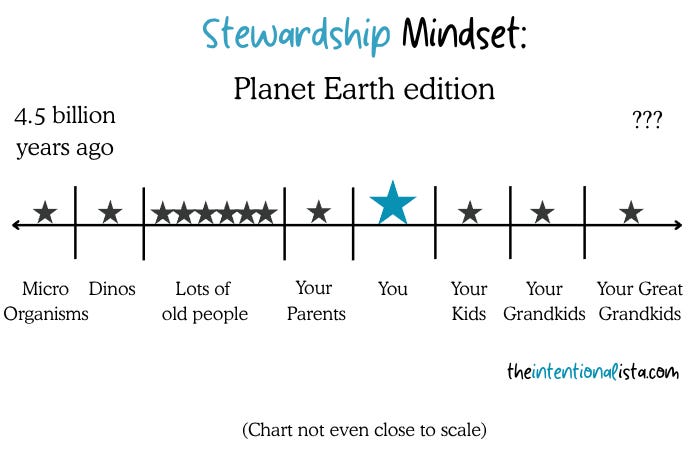
Item stewardship is really about planet stewardship, just on a much smaller scale that’s actually in our control.
Right now, we’re just Earth’s current tenants. But how well we take care of it and leave it for the next ones to enjoy is up to us.
Until next time,
Jenny