

004. Making secondhand feel second nature
Moving from experimentation to ingrained behavior

If you’ve read my last two posts, then you know how genuinely excited I’ve been (maybe even to an embarrassing extent) about experiencing the wonders of secondhand shopping.
Holding a Swap Event at my kids’ school made me feel really proud, and leaving Rhea Lana's with my $97 worth of great finds made me feel like I had hit the jackpot.
Taking these actions felt like a step in the right direction toward reducing my impact on the planet. But so far I had only focused on kids’ stuff. The low hanging fruit.
Eventually my husband or I would need or want to get something new. What would I do in that case? Would I be able to maintain the excitement — and do the hard work — of seeking out secondhand with any actual regularity?
I’ll admit that it seemed a like a big departure from what I was used to. Especially because I’m someone who tends to be a brand loyalist and a bit of a stickler when it comes to things like sustainability certifications and higher quality materials. Even at the Swap and Rhea Lana’s, I was the crazy mom discreetly checking tags for brands I already trusted. Was I really up for doing that every time (or even most times) I shopped?
Channeling my inner Carrie Bradshaw…I couldn’t help but wonder. Had I actually changed my behavior for good, or were these just fun, one-off experiments? How could I make secondhand feel more second nature?

Like any behavior shift, learning to shop secondhand with more frequency will take time to…well, shift. There is a lot of research out there about the practice and dedication it takes to change a mindset or develop new habits.
According a 2024 Scientific American article, “a landmark 2009 study on habit creation found that habits typically develop in a range of 18 to 254 days,” depending on the type of activity. Something like eating a piece of fruit with lunch takes an average of about 66 days to reliably incorporate into your life, whereas developing an exercise habit can take new gym-goers six weeks of exercising at least four times a week.
The bestselling book “Atomic Habits” also talks about four laws of behavior change to build a good habit: Make it obvious, make it attractive, make it easy, and make it satisfying. So far, I had gone totally out of my way to shop secondhand, so the “easy” part still felt especially out of reach.
But I decided to give myself some grace. I have been buying new things my entire life. I knew it would probably take a while for anything else to feel natural. But I also knew that I had to keep trying, even if it was messy and I didn’t know quite where to start. The actual goal was progress, not perfection.
Then one afternoon, not long after riding high from my first wave of secondhand shopping, I listened to a Selling Circular podcast episode about a company called Beni. I remember my mouth kind of falling open as I listened, like this episode was meant to find me when it did.
If you are not familiar with Beni, it is a free extension you can install on your web browser, e.g., Chrome, Safari. Whenever you visit a product detail page on an shopping website like Nordstrom, Anthropologie, Ugg, etc., the Beni symbol will pop up on the right side of your screen, and it will show you where you can find the exact same item (or very similar) secondhand. It does this by automatically scraping more than 40 resale platforms like ThredUp, Poshmark, eBay, The RealReal, Patagonia Worn Wear, Vestaire Collective, etc. in order to find you the lowest prices on that item. I had to try it.
Here is an example of it in action:
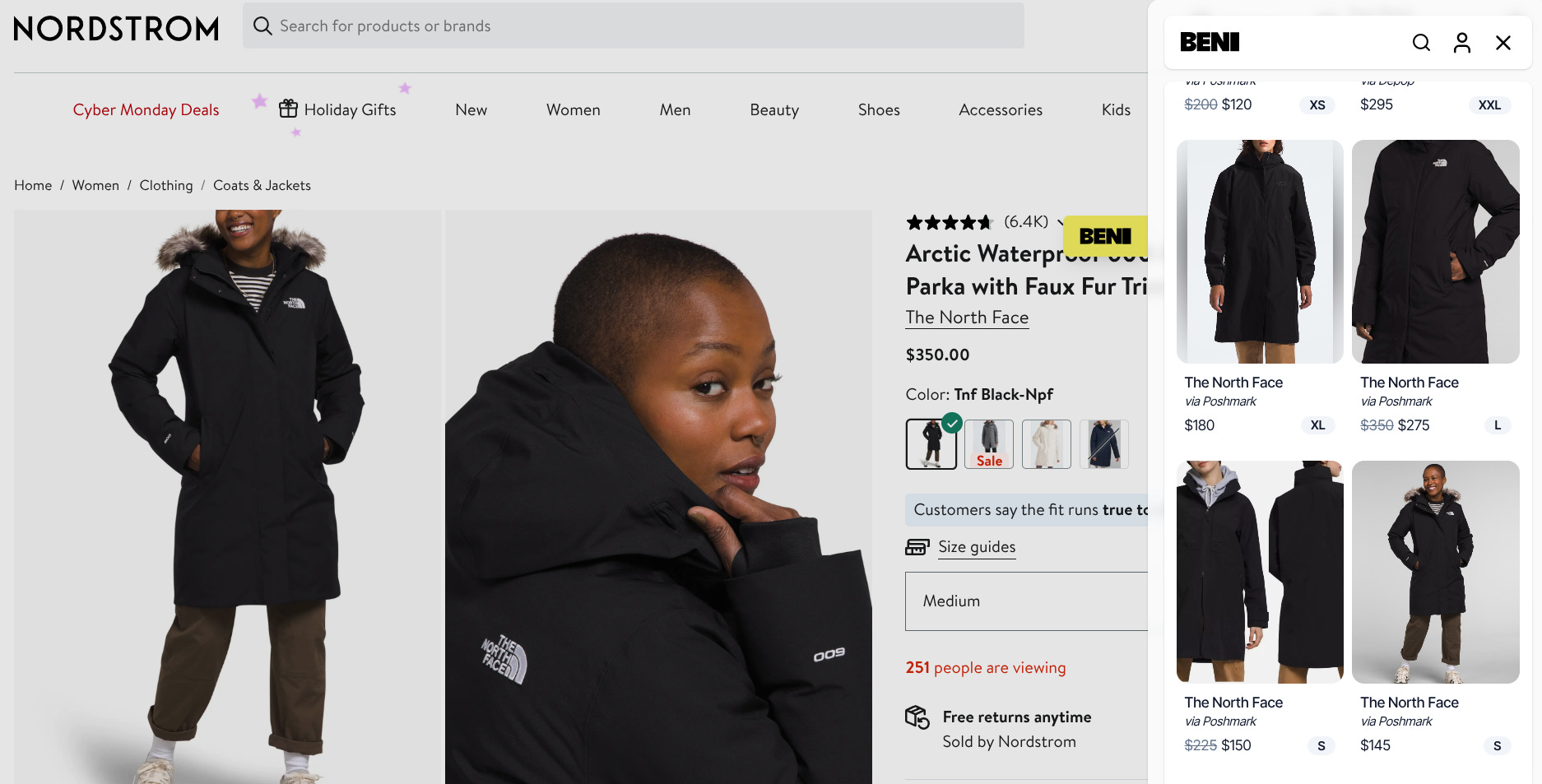
This tool is a total game changer for the world of resale, but especially for shoppers like me who are actively navigating a transition between “the old way” and “the better way”.
It makes the process of buying secondhand feel effortless, because it literally meets me where I am: on a site I’m already comfortable using.
The Beni popup acts as a gentle reminder that the exact thing I’m shopping for already exists in thousands of other closets. It’s like a tap from a little Intentionalista angel on my shoulder saying “are you sure you need that brand new?”
It’s the same item I already want. The same brand I already love. Just secondhand. Talk about an easy way to make the habit stick.
In fact, if we compare Beni against the “Atomic Habits” laws for building a good habit from earlier — it is actually kind of amazing. ✨
‼️ Make it Obvious - Whenever I shop online, there’s now a little yellow popup I can’t ignore.
👀 Make it Attractive - What is more attractive than seeing the same item and brand I already want, just at a lower price somewhere else?
✅ Make it Easy - I click a link to take me exactly to the secondhand item I want on a third-party resale platform site, totally seamlessly.
🙌🏼 Make it Satisfying - Buying secondhand gives me immense satisfaction, knowing I got a great deal and that I did my part to reduce my impact on the planet.
Needless to say, it has become one of the newest default tools in my intentional consumer tool belt. I am currently in the middle of building a “Thrift Wishlist” on Beni and am using it for some holiday gifting this year. I will report back with some of my finds later this month!
Now, in case you’re brand loyal like I am, but you’re still hesitant about using third-party resale platforms, I have *another* great tidbit to share with you: there is something called branded resale. And it’s currently exploding. 🚀
Let me explain what I mean.
What started out as third-party platforms popping up here and there as places to buy and sell used items (starting with eBay as the real pioneer in 1995), has now grown SO MASSIVELY to the point of needing a Beni-type solution to aggregate all the platforms and make it easier for people to find what they are looking for.
At the same time, this growth has also caused another market shift to happen — a shift where brands themselves are starting to see a huge opportunity to bring resale in house, recapturing revenue from secondhand sales of their items that would otherwise take place on third-party sites.
According to an June 2025 article on Retail Brew, a well-known retail industry publication, the first brand to take the leap into resale was Eileen Fisher in 2009 with “Eileen Fisher Renew”. Then it took a whopping eight additional years for the next brands — Patagonia and REI — to set up their own branded resale programs (Worn Wear and Re/Supply, respectively).
As of October 2025, according to ThredUp’s Recommerce 100, which tracks the number of brands with in-house resale programs, there are now…155(!!) that offer their own resale programs.
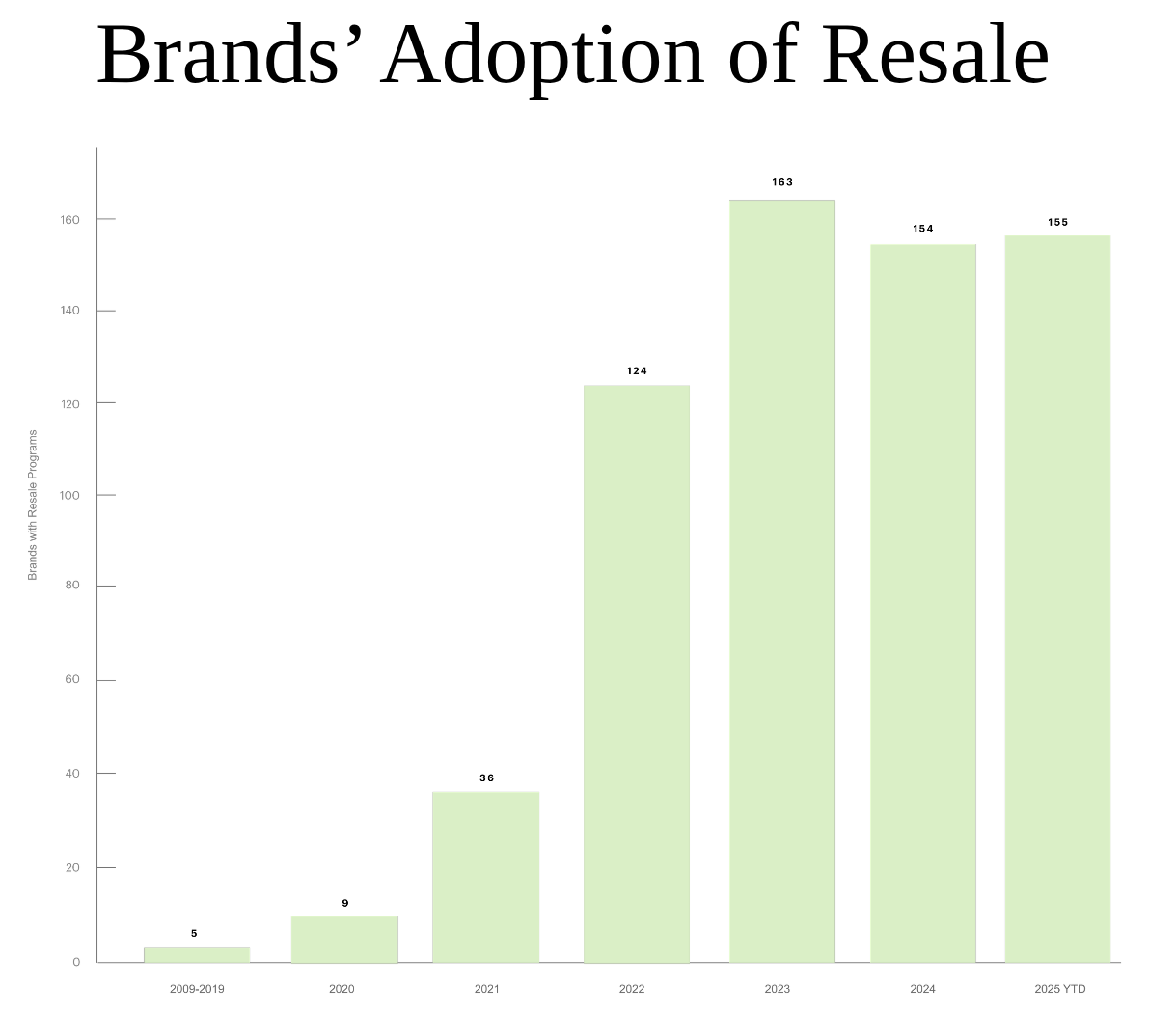
Source: ThredUp’s Recommerce 100
Pardon the expletive, but this quote from the Retail Brew article I referenced above summarizes the state of affairs quite well:
“Brands are like, ‘Well, sh*t, if this is going to be part of what my customers are going to do for the rest of their lives, we should probably pay attention to this,’” [ThredUp CEO James] Reinhart said.
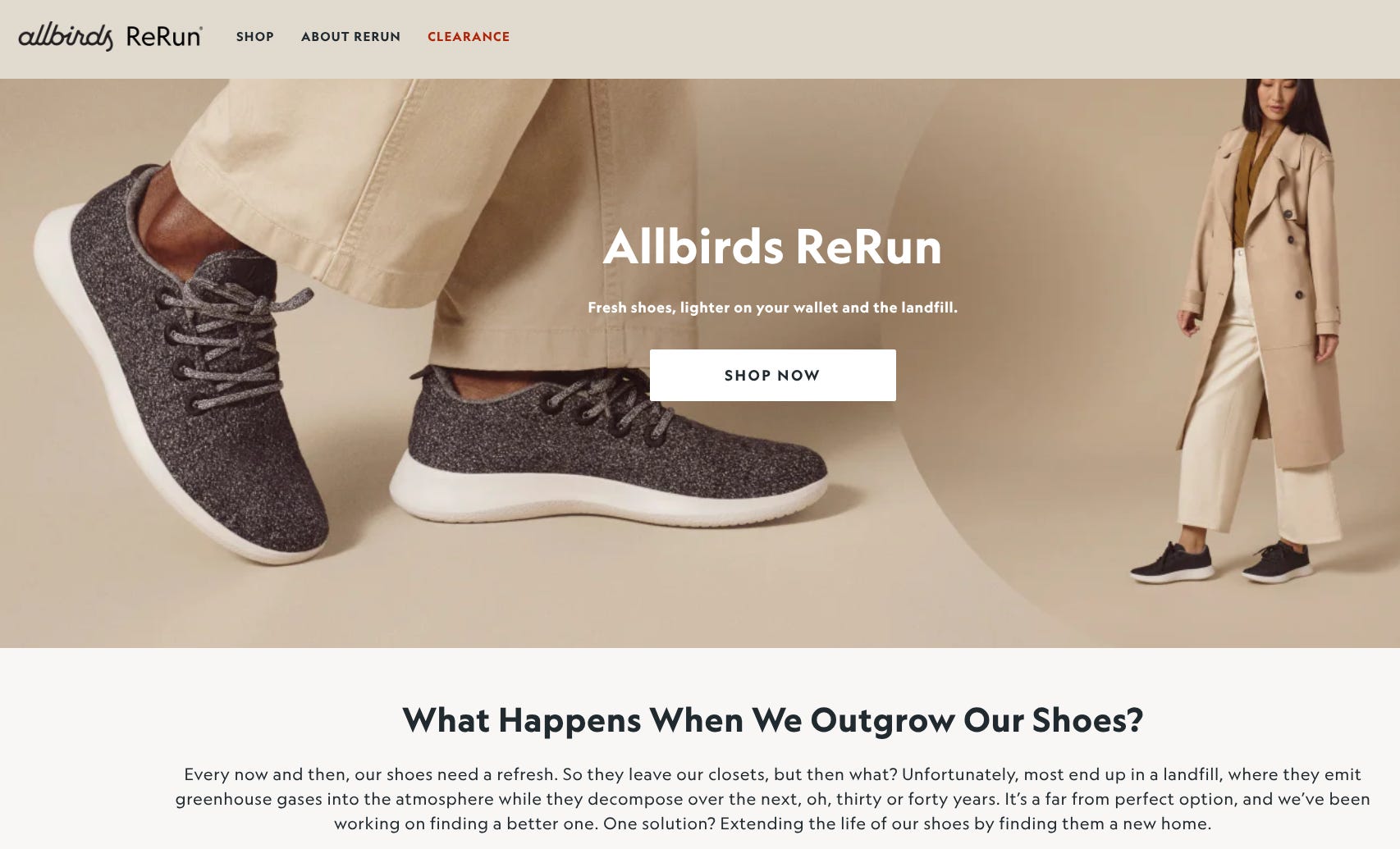
Some of my favorite brands have already entered the in-house branded resale arena. For example, did you know that Hanna Andersson has “Hanna-me-downs”? (Um, adorable). Allbirds has “ReRun”? Even Lovevery, a non-apparel children’s toy brand I love, has Lovevery Pre-Loved. Chances are becoming pretty good that other brands you love are starting to invest in their own resale too.
And the cool thing is, these types of programs allow you to SELL or trade in your branded stuff too. It’s not just about buying!
Here’s a look at Allbirds’ ReRun page:
So if you have never been a secondhand shopper before, or you are tempted to try it but don’t know where to start — this is truly the perfect time to dive in (or even just get your feet wet). There are more ways than ever before to participate: in person, at consignment shops, online, at Swaps, at your favorite brands — wherever and however it works best for you.
You could even start with just selling your existing stuff, getting some cash, and giving other people more opportunities to find secondhand gems.
I want to leave you with this quote from “Atomic Habits”. It is a wise reminder that all meaningful changes take time, and that wherever you are on your own journey to becoming more intentional, you just have to keep going.
“All big things come from small beginnings. The seed of every habit is a single, tiny decision. But as that decision is repeated, a habit sprouts and grows stronger. Roots entrench themselves and branches grow. The task of breaking a bad habit is like uprooting a powerful oak within us. And the task of building a good habit is like cultivating a delicate flower one day at a time.”
-from “Atomic Habits” by James Clear
I can’t wait to try out Beni! Thanks for the tip! Two additional tricks that I used to get myself further into secondhand-land were to A) sell some of my clothes via a local consignment shop and take my payout in store credit rather than cash, which made me want to stop in even more - probably works online, too, and B) have lists of items that I’m only allowed to buy secondhand (sweaters, button down shirts, skirts, scarves, etc) and a list of new-is-ok which includes harder to fit categories, like shoes for my weird feet.
Thank you for introducing Beni! Making secondhand online shopping that much easier!