

012. Where should all "The Rejects" go?
What to do with clothing and textiles that no one else will take.

Over the last year, I’ve parted ways with a LOT of clothes our family no longer needs.
I donated some. I consigned some. I handed some down to an expecting mom friend. I swapped some at a Swap Event. But even after all that purging, I’ve found that there always seems to be a sad little pile leftover in the corner that I still don’t know what to do with.
You know the pile I’m talking about…it has things like:
🩲 Ratty underwear that has seen better days.
🧦 Threadbare socks with a hole that fits your entire big toe.
👟 A single shoe with a giant hole in the rubber sole.
🩱A stretched out swimsuit that no longer fits your mom or dad bod.
👖Old jeans torn up beyond repair.
👙Used nursing bras I don’t need and regular bras that don’t fit me anymore.
These are just a few examples of what I affectionately refer to as “The Rejects”.
Donation centers and Swap Events don’t accept them.
You can’t hand them down.
Most of the time, they’re way past “gently used” or “functioning”.
And yet, if you’re anything like me, you still hate to throw them straight in the garbage. 🤦♀️
So for this post, I’m sharing some of the alternative options I’ve explored for getting rid of The Rejects in your life — and you might be pleasantly surprised at how many there are!
Before we dive in, let me first say that this post is only focused on clothing and textile rejects. I will do several future posts about other items that are notoriously hard to get rid of responsibly, such as batteries, light bulbs, paint, electronics, etc. (Make sure you subscribe to follow along!). But for now, we’re just talking textiles.
Paid Mail-In or Pickup Services
There are currently four major players that gladly accept The Rejects in the form of paid mail-in or pickup bags/boxes. I personally gravitate to these options because they are the most convenient — they don’t involve separating items out by type or remembering a specific donation drop off date. However, I’ll also share some great free and item-specific options later in the post, too!
Here’s a rundown of how each one works, what they take, how much it costs, and what actually happens to your stuff after you send it in.
1. Trashie
Trashie features a $20 “Take Back Bag”, which you can stuff with up to 15 lbs of clothing and non-clothing textiles in any condition. This includes bed linens, towels, swimwear, underwear, blankets, socks, handbags, accessories, even single shoes(!), with some caveats here. They also offer separate cotton fabric scrap bags ($15) and kids take back bags ($10). You simply scan a QR code on the bag to produce a prepaid return label, and drop it off at a UPS store (very similar to an Amazon return).
They offer “Trashie Cash” rewards when you send in a bag — ranging from gift cards to familiar large retailers to donations to places like dots.eco, which supports vetted environmental impact organizations that are planting trees or saving sea turtles. (I had never heard of dots.eco before Trashie, but it’s a great concept!)
Their website indicates that 95% of what they receive is kept out of landfill. However, they don’t share many concrete details about their reuse or recycling partners, other than mentioning that “around 70% are reused globally, while over 20-25% are recycled into new fibers for uses like pet bedding and building materials.”
2. Ridwell
Ridwell offers a convenient $20/month porch pick up service for many different types of hard-to-recycle items, including a category called “Recyclable Threads”. This category covers things like worn out socks, underwear, rags, towels and blankets. They also have a separate category called “Clothes and Shoes” that is meant for reusable items.
Ridwell partners with a textile recycling company called Phoenix Fibers to convert The Rejects to “shoddy fiber” that is used to create insulation or fiber filler. Anything actually reusable gets sent to a partner called Cycla, which connects the items to wholesale buyers at thrift stores or sustainable fashion businesses. They also partner with four different bra reuse/recycle organizations that support victims of sex trafficking, domestic violence or homelessness.
You might recall Ridwell from one of my earlier posts (and I’m a big fan!), but unfortunately the “Recyclable Threads” category is only offered through their Pick Up subscription, which is not available everywhere. So as a Ridwell Mail-In customer, I sadly don’t have access to this feature. (Check if your city is one of the lucky ones here).
3. Retold Recycling
Retold Recycling is a Shark Tank alum that struck a deal with Mark Cuban! They offer a variety of mail-in bags (all made of compostable cornstarch), including their $15.50 classic bag, which holds up to 5 lbs of clothing and textiles in any condition. They accept everything from old underwear and socks to household linens and old dog blankets. They also have a separate Fabric Scraps bag for crafters.
Each bag arrives with a prepaid shipping label already attached. You simply fill the bag and drop it into any USPS mailbox. Like Trashie, they offer a rewards program, but Retold only partners with brands that are committed to sustainability, including ones like Blueland and Dropps. However, these incentives are structured as a perk for their subscribers rather than a one-off cash-back per bag system.
According to the Retold website, once the items are sorted, they “go to US thrift stores, charities, upcyclers or recycling companies, and fabric scraps bag go to a US downcycler to be transformed into reusable fiber.” But there isn’t a whole lot of detail beyond that about specific partners they work with.
4. TerraCycle
TerraCycle is the most comprehensive (and most expensive) option of the group. It offers Zero Waste Boxes for fabrics and clothing in three sizes — ranging in price from $160 to $379 — which are designed to hold any clothing, fabric or textiles, with some caveats listed here. They also have a wide variety of other types of items they will accept in Zero Waste Boxes or pouches (but you have to buy separate boxes or pouches for each type).
The box arrives with a prepaid shipping label. Once you fill it, you can tape it up and drop it at any FedEx location or arrange a FedEx pickup. TerraCycle does not offer any rewards for their Zero Waste Boxes. Based on the pricing and size of the boxes, it is best suited for businesses rather than individuals (but that’s my own two cents).
They are known for their transparency and their Recycling Guarantee, which states that they “guarantee to recycle all the accepted waste sent to us,” which amounts to 98.3% once contaminated items have been removed. After recycling the waste into raw material, it becomes filler for things like mattresses and pet bedding. They even sell products on their website that are made from the recycled material they collect from their other types of Zero Waste boxes, which I thought was cool!
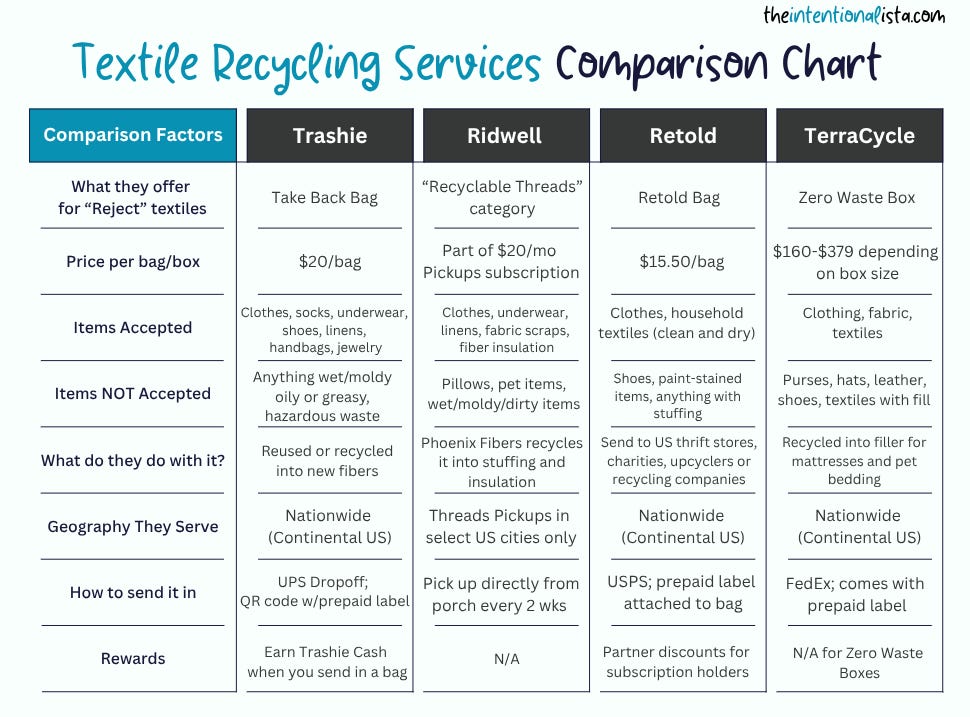
Now, just in case your eyes are hurting from reading all that text and trying to figure out which one is best for you, I created a handy chart to compare them all side by side:
My experience trying Trashie
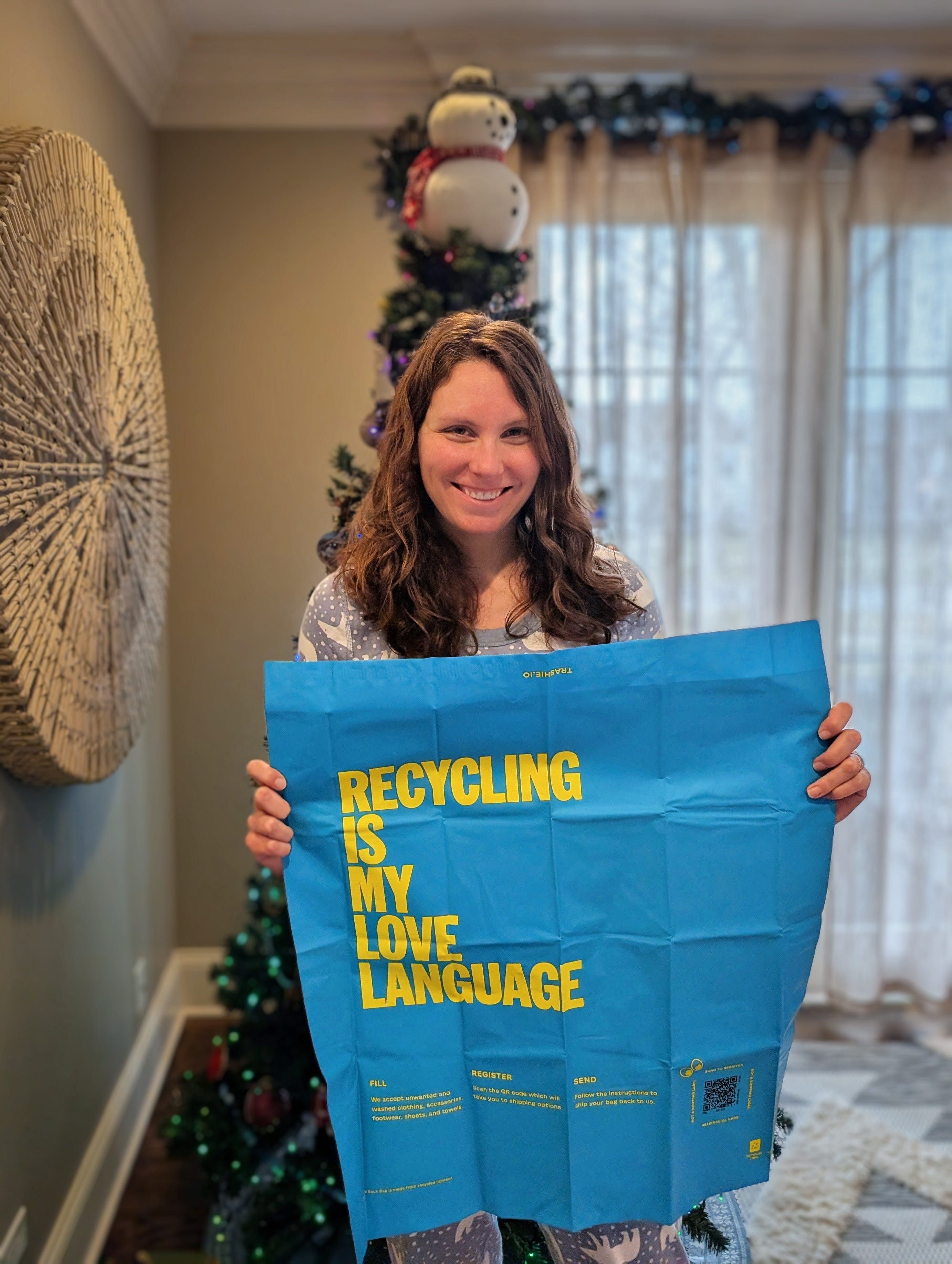
Well, I must complain about The Rejects too much, because I actually received Trashie bags as a Christmas gift from none other than my thoughtful husband (who knows that the way to my heart is through the recycling bin). ♻️
I also saved the gift label because it made me smile!
Since I have actually tried Trashie firsthand, I wanted to share some thoughts about my experience.
What I love about it:
❤️ I love that the bags get shipped directly to me.
❤️ I love the convenience of throwing most of my Reject pile into one bag and not having to separate things out by item type.
❤️ I love that I’m extending the life of items that would otherwise be garbage, down-cycling them into useful materials.
What I’m “ehhh” about:
🧐 I think it’s a bit tricky to offer rewards (especially gift cards for retailers) for this type of thing. It almost feels like promoting a guilt-free end-to-end shopping experience, since I can just dump everything in a bag when I’m done. To me, that mindset just perpetuates the cycle of over-consumption. (And I should be clear that I feel this way about any program that uses shopping rewards as incentives for clothes recycling — not just Trashie).
That being said, if you are mindful about how you use the Trashie Cash, it can be a nice perk and a way to recoup a small bit of the cost of a bag. I personally love the dots.eco option!
What I’d like them to improve:
🫤 The level of transparency. As opposed to Ridwell and TerraCycle, which are super clear about where your items end up, Trashie is more opaque. They provide high-level data about how much they divert from landfill, but they don’t provide a ton of details about their reuse or recycling partners on their website. Personally, I like to know what happens next so I can feel like I am part of a solution, so it’s a bit of a letdown that they don’t have more specific information readily available. This is an easy fix, Trashie!
My overall take:
Trashie is an easy and convenient way to get rid of my true “Rejects”, and I’ll continue to use it for those. I love that my sad little holey socks will be repurposed into something useful instead of sitting in a landfill.
However, I personally still prefer other methods (consignment, resale, handing down, swapping) for getting rid of clothing that’s still in usable condition (even though Trashie would take it), just because I don’t have a great sense of what they actually do with it. They mention it gets used “globally,” but that makes me automatically envision it going to countries that are already buried in our textile waste. Again, more transparency here would quell that (potentially incorrect) assumption!
Other Free Options
If you don’t want to spend any money to toss your Rejects (totally understandable!), I’ve included some great free options below as alternatives.
Your local municipality
Many cities or smaller municipalities offer free textile recycling drop off programs at specific times during the year. Some even offer other specialty item drop offs for batteries, light bulbs, etc. Check your city’s local government website for details.
Drop offs at major retailers
There are actually some well-known retailers that will take your old clothing (even The Rejects!) in drop off bins at their stores. The only tricky thing here is to resist the urge you may feel to go shopping for something you don’t actually need right afterwards. 🙃
Here is a short list of some retailers who offer clothing drop off bins. Just call your local store to double check before you go, as this list may be subject to change in the future.
Zara - Accepts any brand of clothing, footwear and accessories (no voucher provided)
H&M - Accepts any brand of unwanted clothing or textiles (provides reward voucher)
J.Crew - Accepts any brand of swimwear — note: mail in only (provides $5 credit per piece)
Madewell - Accepts any brand of denim (provides $20 off new full-price jeans)
American Eagle - Accepts any brand of denim (provides $10 off new jeans)
Soma - Accepts any brand of gently used bras (provides $10 off new purchase)
Bra Recycling
The Bra Recyclers is a specialty organization focused on recycling bras and underwear to benefit organizations serving homeless individuals and domestic violence survivors. They are not necessarily focused on The Rejects, (they will accept bras in gently used condition), but I figured they were still worth a mention, since bras are definitely one of those things people don’t know what to do with — in any condition.
In fact, bras are the only thing I intentionally kept out of my Trashie bag because I was a bit unclear if they actually accepted them (it only mentioned sports bras on their website’s FAQs), so I plan to take my underwire bras to a free Bra Recyclers drop off location near me. Check out their locations here.
The Bottom Line
There are *plenty* of options out there for your Rejects besides the garbage can! While I’ve chosen to highlight the major players, there are quite a few more that accept their own branded items in-store for recycling, as well as some additional specialty mail-in services. Some require more planning and effort (and expense!) than others, but there’s bound to be one that works for your needs.
It’s also worth calling out that NONE of these services (even the free drop offs) accept anything wet, moldy, oily, greasy or hazardous, as these will contaminate the batch. Keep everything dry and as clean as possible.
Which method appeals to you the most? Let me know what you think!
Regardless of what you choose, I hope a much smaller (or non-existent) pile of The Rejects is in your future!
Until next time,
Jenny
So glad you found it useful!! Municipal textile recycling is definitely a great option!