

016. A Latin phrase that helps me focus on the present moment (and the tools that help me reinforce it)
Because living with intention can only happen when you're paying attention.

I’m going to start this one off by setting a few scenes.
▶️ You’re sitting down to dinner at your kitchen table, and you pull out your phone to watch a YouTube clip for some light entertainment during your meal.
🥪 You’re extra busy at work, so you decide to take lunch at your desk to power through emails in between bites of your turkey sandwich.
🎥 You’re on the couch watching a movie with your spouse, but you’re also silently scrolling social media at the same time.
💻 You’re on your laptop to look something up, but a text message pops up on your phone and sucks you in, completely derailing your research.
Any of these sound familiar? I’m guilty of all of them. Like, painfully guilty.
You might also recognize what usually happens right after each of these scenes…
🤦🏻 You get up from the dinner table, not having registered what you ate or whether you’re actually full.
🤦🏻 You answer half of an email and get through only half of your sandwich.
🤦🏻 You lose track of the movie’s plot and ask annoying questions like “wait, who is that guy, again?” And then the movie ends without you actually feeling any more relaxed.
🤦🏻 You never actually research that thing you wanted to look up.
These scenarios are familiar to all of us because we live in a culture that glorifies multi-tasking. After all, doing more than one thing at once is often viewed as the only way we’ll ever have time to get it all done. As a mom of young kids, I know this all too well.
But according to a 2010 scientific study, only 2.5% of people are able to multi-task effectively. TWO. POINT. FIVE! (I’m clearly not one of them).
In an 2021 article by the Cleveland Clinic, Neuropsychologist Cynthia Kubu, PhD, explained, “we’re really wired to be monotaskers, meaning that our brains can only focus on one task at a time. When we think we’re multitasking, most often we aren’t really doing two things at once. We’re doing individual actions in rapid succession, or task-switching.”
Task switching increases our cognitive load, making our brains work harder (and get tired faster) from trying to cram too much in at once.
And it’s really hard to live with intention when you’re not even fully present.
The best advice I ever received as an antidote to multi-tasking came from a Jesuit priest back in 2008.
I can’t remember his name anymore, sadly, but I’ll never forget the three simple words he taught me when I was a senior at Creighton: Age Quod Agis.
It’s a powerful Latin phrase that translates to do what you are doing.
Back in college — and for many years thereafter — I would whisper “Age Quod Agis” to myself whenever I felt my brain actively pulling away from the current moment or task. Sometimes it would work, and I would listen to that little voice in my head.
But too many times, I would brush it right off and continue right on down the distraction rabbit hole. (Sometimes you just get sidetracked because you HAVE to know if that one Bachelor couple from three years ago ended up getting married, and then you need to find out what their kids names are, OK??)
So over the past year, in my quest to be more intentional about how I live and spend my time, I’ve experimented with some better tools and systems to help me reinforce this concept, rather than relying on the good graces of the voice inside my head.
Here are three simple things that have worked the best.
1. Defining Boundaries for Spaces in My Home
For me, there is nothing worse for focus than trying to accomplish something in a room that’s not intended for that purpose.
Like when I try to answer an important email in the kitchen, where my kids can start tugging at me to make them a snack. Or when I try to finish reading a thought-provoking article while my kids are climbing on me in the playroom.
What I’ve found really helpful is to define boundaries for different spaces in my home.
For example:
When I’m in the kitchen, I’m preparing food or eating.
When I’m in my home office, I’m working.
When I’m on the couch/in the family room, I’m relaxing and socializing.
When I’m in the playroom, I’m playing with my kids.
In other words, I defined what I should be doing in each space — and by default, what I should NOT be doing in those spaces (like eating in my home office or working while I’m on the couch). Simply defining it reminds me to be present in that space rather than distracted by something else.
Having these boundaries also triggers me to do things like putting my phone away when I’m at the table or playing with my kids, or walking to the kitchen for a snack instead of eating at my desk. It also helps me actually relax when I want to relax, and actually enjoy food and others’ company during meal times.
It’s not something I do perfectly 100% of the time (and that’s not a realistic expectation for anyone to have), but as a general rule, defining the boundary automatically gives me a quiet “do what you’re doing” nudge each time I feel myself drifting back into multi-tasking mode. And it works more often than not!
2. Using Brick
As you can probably tell from this post, there is usually a single culprit for all my multi-tasking woes: my phone. Oh, and my toddlers. But mostly my phone. I’m going to take a wild guess that it’s the same for you.
But since we need our phones for lots of useful things (not just distractions), the answer is not to avoid them completely. Like chocolate cake or Ben & Jerry’s — it all comes down to moderation.
One thing I’ve found to be really helpful for minimizing phone overuse and improving focus is an app limiter device called Brick.
Unlike focus modes on your phone, which can be easily turned off if you want to ignore them (ask me how I know), Brick is a small, square-shaped device that you can only override by physically tapping it with your phone.
You can customize which apps it can block, and once your phone is “Bricked”, you will get a popup like this every time you try to access it:
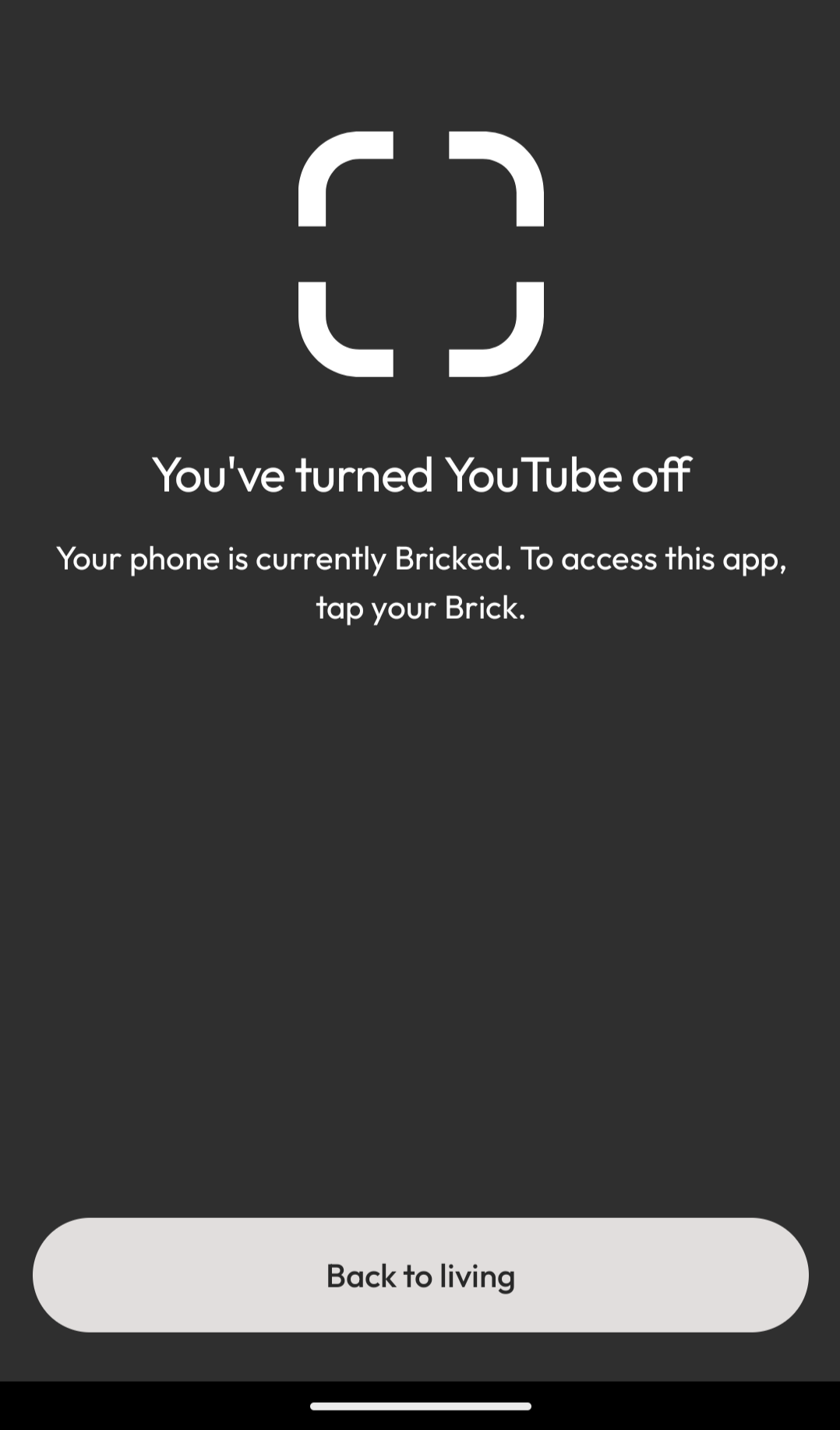
Don’t you just love the “Back to living” button at the bottom?!
The trick is to keep the Brick in a location far enough away from what you’re trying to focus on, so you aren’t tempted to un-Brick it easily.
I keep mine hidden in a cabinet in the kitchen, and most of my work is done upstairs. But I’ve even heard of some people Bricking their phone before they leave for work so they can’t un-Brick it until the'y’re back home. That’s commitment!
I have found this tool especially helpful when I am doing deep work that requires real focus. But I also use it when I am eating meals with my family, and before I head upstairs for bed (which helps me end and start the day more peacefully than I would with mindless scrolling).
The great thing about it is that you can get one Brick for multiple users, so my husband and I share one device. And not to worry — it lets you have five emergency unlocks in case you lose the Brick or need to access a blocked app on your phone urgently when the device is not nearby.
Total game changer.
3. “I am [doing X] right now”
On a fairly recent Daily Jay meditation called “Open Tabs” (read more about the Daily Jay and the Calm app here), author and former monk Jay Shetty talked about this exact phenomenon of trying to do too many things at once (and failing).
He shared a very simple but powerful mindfulness exercise to combat this.
Whenever you find yourself in a situation where you feel yourself losing focus, remind yourself “I am [doing X] right now” and gently pull yourself back to the task or activity at hand.
For example, if you are reading a book, but you randomly remember you forgot to fill out that one field trip form, say to yourself, “I am reading a book right now”.
Or if you are watching a movie on the couch with your spouse, and you reach for your phone to take a quick peek at social media, remind yourself “I am watching a movie right now.”
You can practice this by meditating (just closing your eyes and focusing on your breathing and the present moment) for a few minutes.
Any time your mind drifts off, remind yourself “I am meditating right now”.
Adding this simple sentence to my repertoire has helped me massively to be more present. It’s essentially Age Quod Agis, but repackaged and easier to pronounce.
I want to leave you with a quote from the Cleveland Clinic article I referenced earlier.
“People assume that a surgeon’s skill is primarily in the precision and steadiness of their hands. While there’s some truth to that, the true gift of a surgeon is the ability to single-mindedly focus on one person and complete a series of tasks over the course of many hours,” Dr. Kubu explains.
I, for one, am glad surgeons are not answering their texts during surgery!
But I also love that Dr. Kubu refers to single-tasking as a “gift”.
What you’re really doing by focusing on the present moment is being intentional about how you spend your limited, precious time. And to your spouse, your kids, your friends, and your future self, that is the best gift of all.
Until next time,
Jenny
Gosh I so feel this. I have a million open tabs right now. Literally and figuratively. I'm downloading Brick today!