

014. Lessons from the Landfill
Behind the scenes of our garbage's forever home. And what I'm doing differently after seeing it up close.

To most people, a landfill exists merely in the abstract. Like a black hole or a Boogeyland of sorts. It’s a place we all know in concept but rarely see in real life.
But a few weeks ago, I scratched the itch I’d been having to go visit one, mostly to get to the bottom (literally, as you’ll see) of a place that is so integral to understanding how we treat — and ultimately reduce — waste.
So if you’ve ever wondered what it’s actually like behind the scenes of a landfill, you’re in luck. I’ll take you with me on a private tour…let’s go!
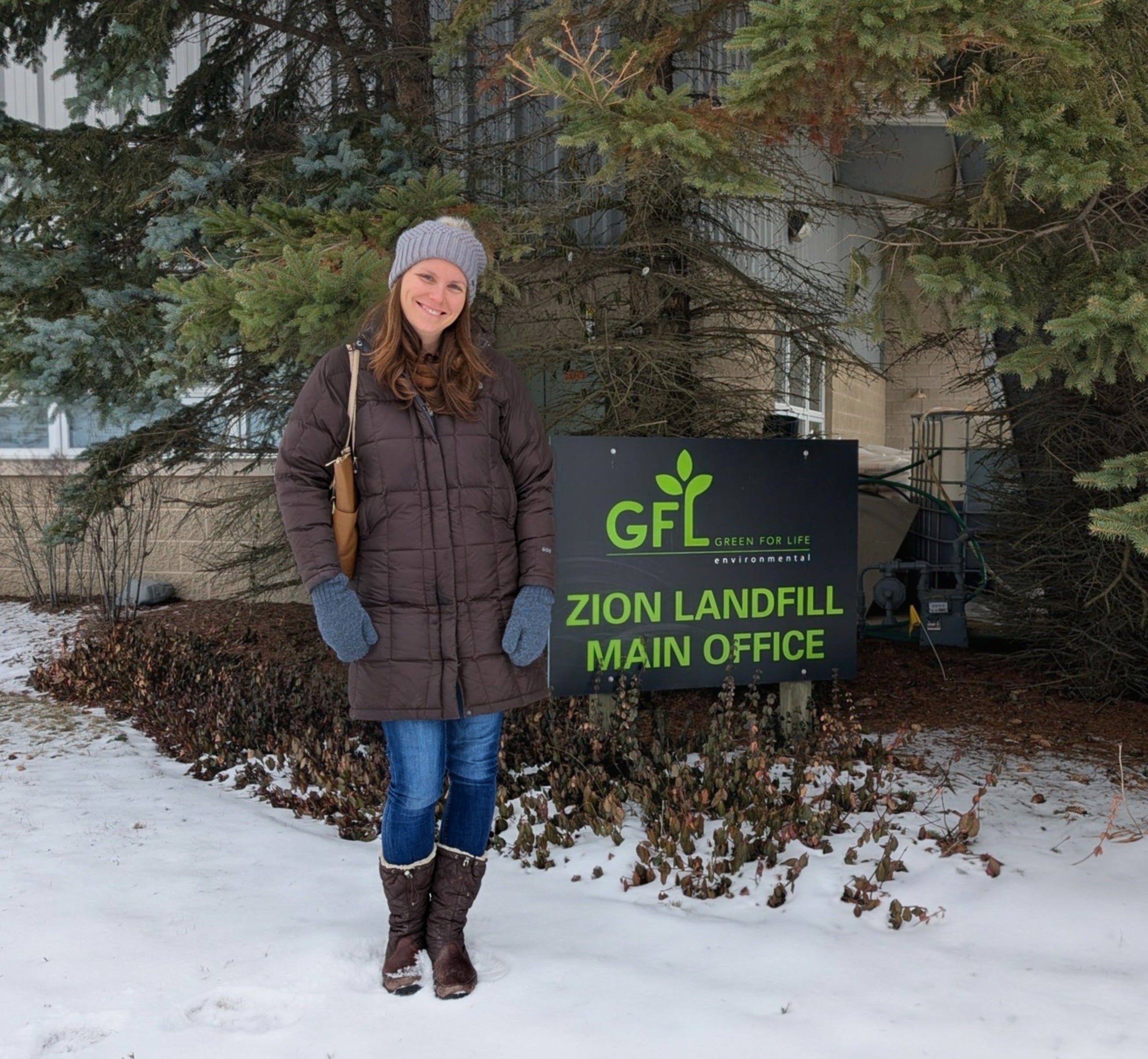
Welcome to the Landfill!
Welcome to the Zion Landfill in Zion, IL, just south of the Wisconsin border. It’s been operating here since 1970.
When you first arrive, you may notice how busy it seems. There is a near-constant stream of trucks coming in and out, which feels oddly depressing. It is a visual reminder of just how much trash we all produce. As the site manager says, “the trash never stops, no matter the weather”.
In the winter, this landfill typically gets 2,000 tons of garbage per day, whereas the summer months typically see 4,500 tons/day, with a max of 9,500 tons/day. The difference between volumes is mainly that construction and demolition projects are more prevalent in the warmer months, and those generate a lot more waste.
For a better frame of reference on just how much trash that actually is, I asked Gemini to translate these figures into the equivalent number of elephants (because for some reason it is always easier to grasp massive numbers like this in terms of elephants…am I right?)
2,000 tons is the equivalent to the weight of 333 African elephants or 150 empty school buses. 9,500 tons is equivalent to the weight of 1,583 African elephants, or 42 Statues of Liberty(!!!). That is A LOT of garbage. And remember, that is in ONE DAY.
But before trash gets buried in the landfill, how does it get there?
The Journey of Garbage
🚛 Picking up from your curb
After a garbage truck picks up your bin from the curb, its next stop is most likely somewhere called a Transfer Station. You can think of a Transfer Station as a local, central hub where lots of garbage trucks unload before going back out into the neighborhoods to collect more garbage.
Much larger-capacity trucks called Tipper Trucks then pick up garbage from the Transfer Station and transport it directly to the landfill.
Tipper Trucks can hold 20 tons, whereas regular-sized garbage trucks carry only between 9-10 tons, so there is a clear efficiency benefit to consolidating trash from many smaller trucks into a Tipper Truck — especially since landfills tend to be far away from most of the residential areas the trash is collected from.
👷♂️ Getting tipped onto the landfill
At the landfill, the Tipper Truck literally tips the garbage onto the giant pile using a really cool hydraulic lift. It’s pretty amazing how high up these things get! Check out the video below of a Tipper Truck in action.
🚜 Getting compacted down
When a fresh load gets added to the landfill, compactors then drive over the garbage to compress it down as much as possible. If you look closely, you’ll notice there are large spikes on the compactor tires, which help to crush down anything in their path. You are not allowed out of the car for this tour, because it is extremely dangerous to be anywhere near compactors. You’d be a pancake in about 2 seconds flat!
💨 Adding dirt and a cloth over top
At the end of the day, the landfill crews add a layer of dirt over the top of the pile and then cover the whole thing with a giant cloth. This is the best way to reduce the smell, limit the impact of wind blowing everything around, and keep it protected from animals and pests.
🔒 Closing up a landfill for good
Once a section of the landfill has reached its max capacity (it must be kept to a certain elevation), they do what’s called a “final cap”. This involves putting a layer of plastic over it, as well as laying 3.5-4 ft. of top soil on the top.
Once a section of the landfill has closed, no permanent structures can be built on top of it. Typically grass just grows on top of it, or in some cases, it can get converted into a public space like a park or golf course. The site manager said one of the most popular places to watch fireworks in Virginia Beach, VA, where he used to live, is called “Mount Trashmore”, a former landfill. Note, closed landfills remain heavily monitored and regulated for 30 years after they close to ensure the health and safety of the groundwater and soil.
🕳️ Digging a new hole
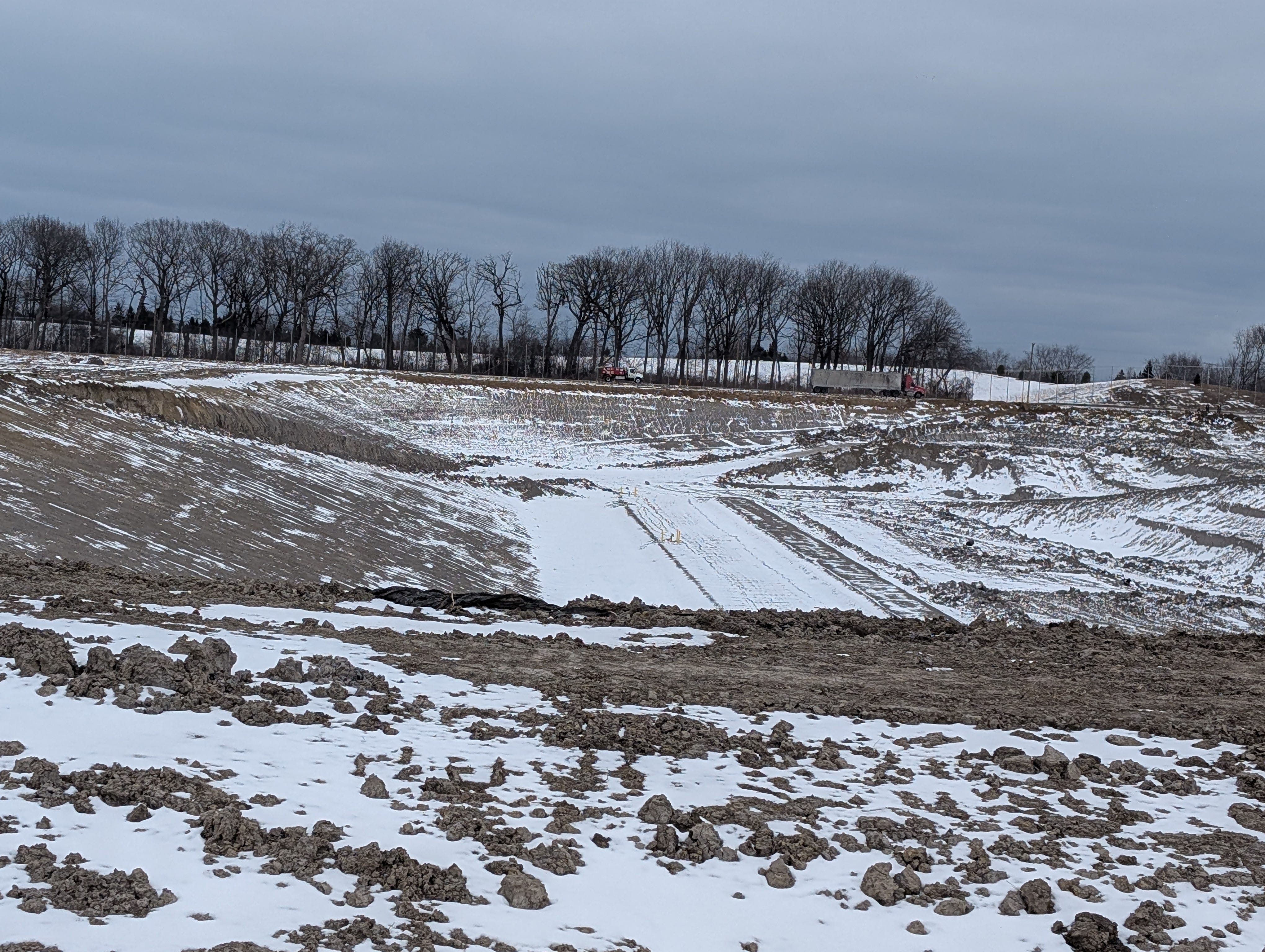
Now, for a tour exclusive. ✨ Here is something most people never see: the bottom of a landfill hole. It’s a bit hard to grasp the breadth and depth from this photo because of the snow, but this hole is 70 ft deep and 10 acres wide! When it’s at final cap, it will be 170 ft. tall (100 ft above ground level).
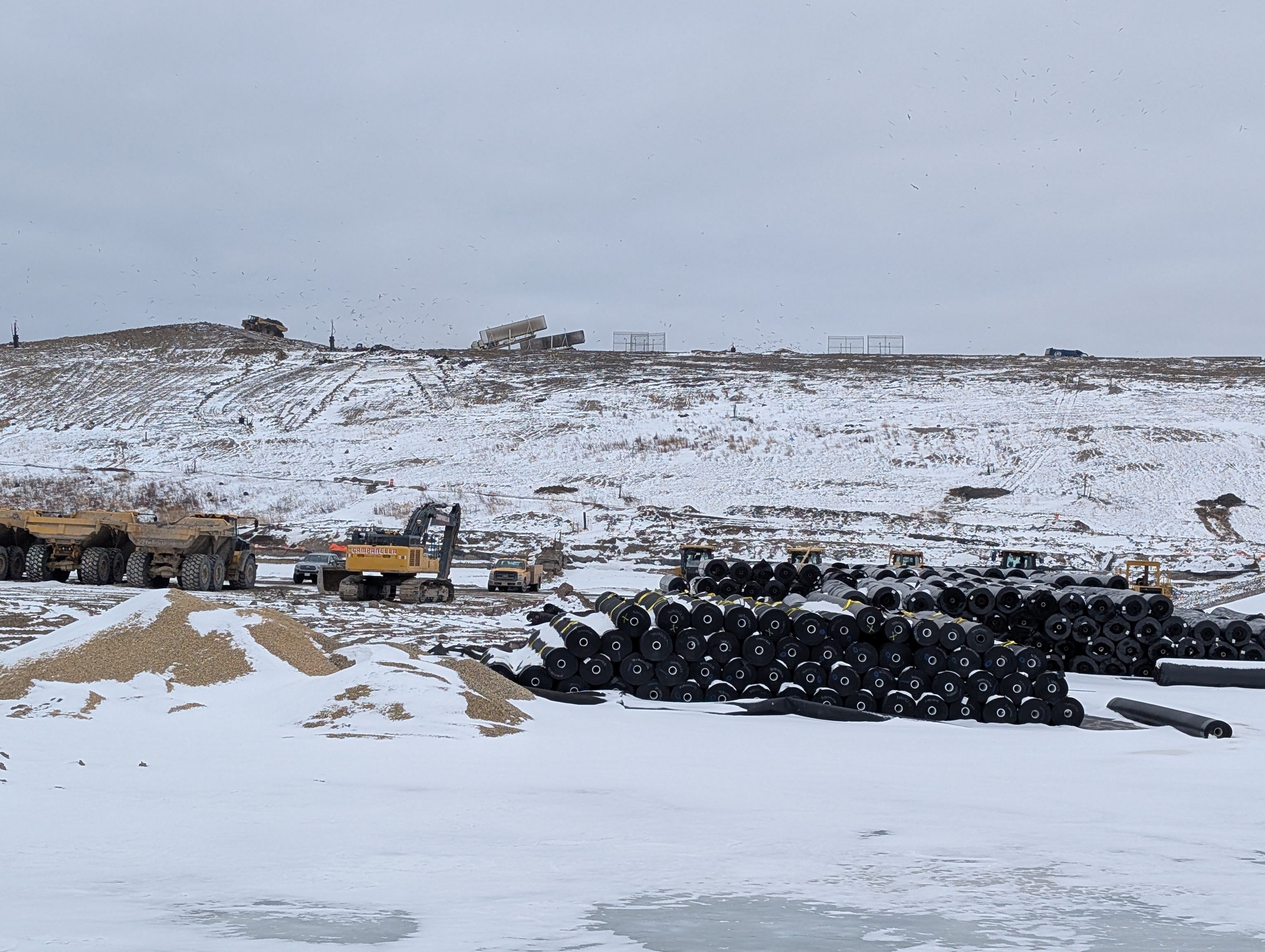
Once the hole is dug, the next step is to lay a thick plastic liner down on the bottom of it. You can see the rolls and rolls of liner in the photo below, just waiting on some slightly warmer weather before it gets laid out.
Can you guess how long it will take to fill a hole that’s 10 acres wide (approx. 7.5 football fields) and 170 ft tall?
The answer is…about 1.5 years. That is FAST. And really sad.
Leachate and Methane
Ok, now I’ve saved the worst for last. The final part of our tour is breaking down two of the nastiest by-products of landfills: leachate and methane.
First, you may have noticed these things sticking out of the ground in the videos above.
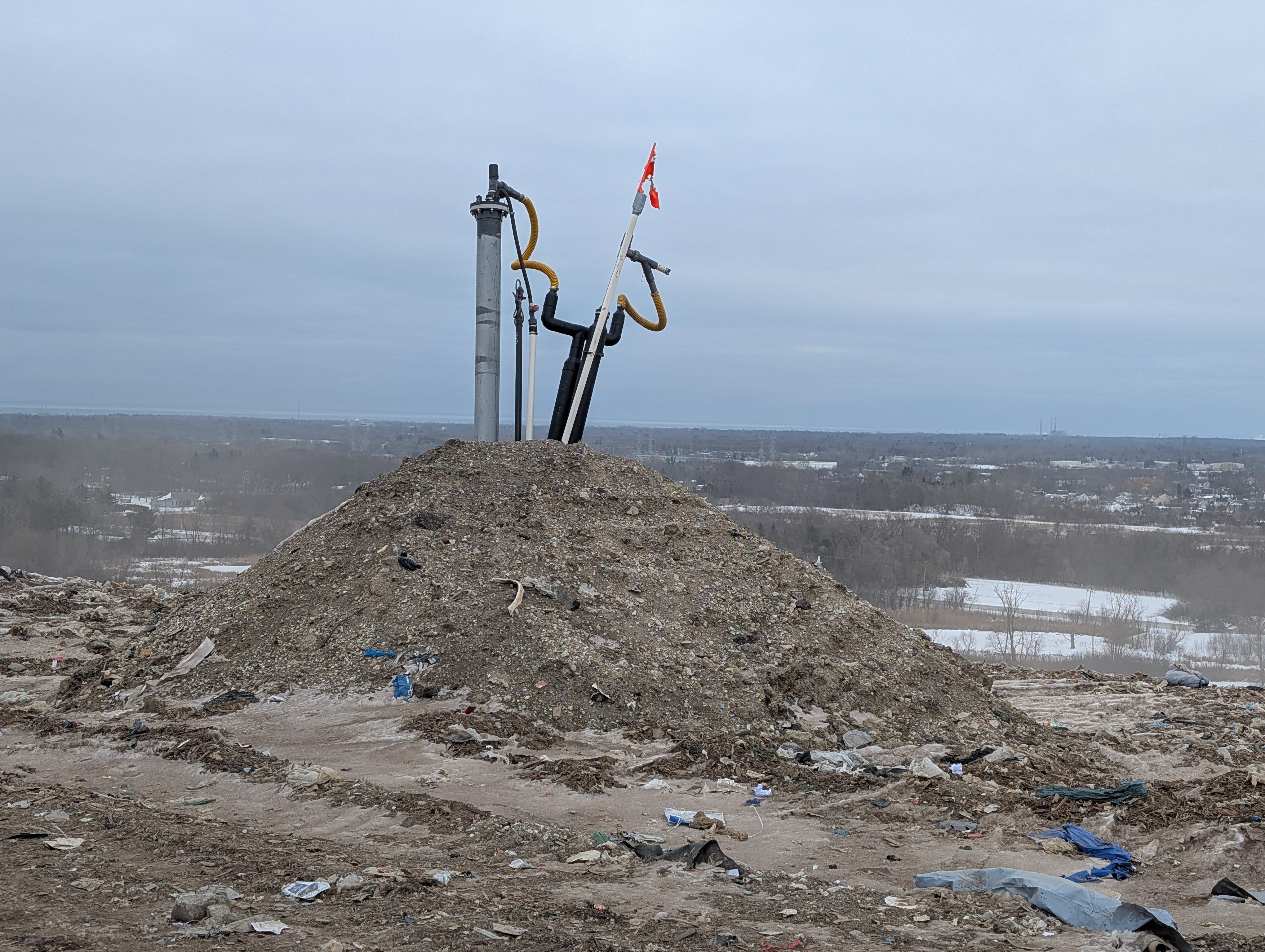
These are like giant straws that suck the “leachate” (think of it as garbage juice) out of the landfill. You’ll see these all over the landfill, even in areas that have been closed off, because the garbage juice keeps flowing as the materials break down over time. Once it gets sucked up through the “straw”, the leachate is hauled to a wastewater treatment plant so it can be reprocessed.
This “straw” mechanism — in addition to the thick plastic liner on the bottom of the hole — plays an important role in preventing the leachate from seeping into the groundwater and soil. It’s heavily regulated and subject to weekly inspections by the health department. No one wants to drink garbage juice!
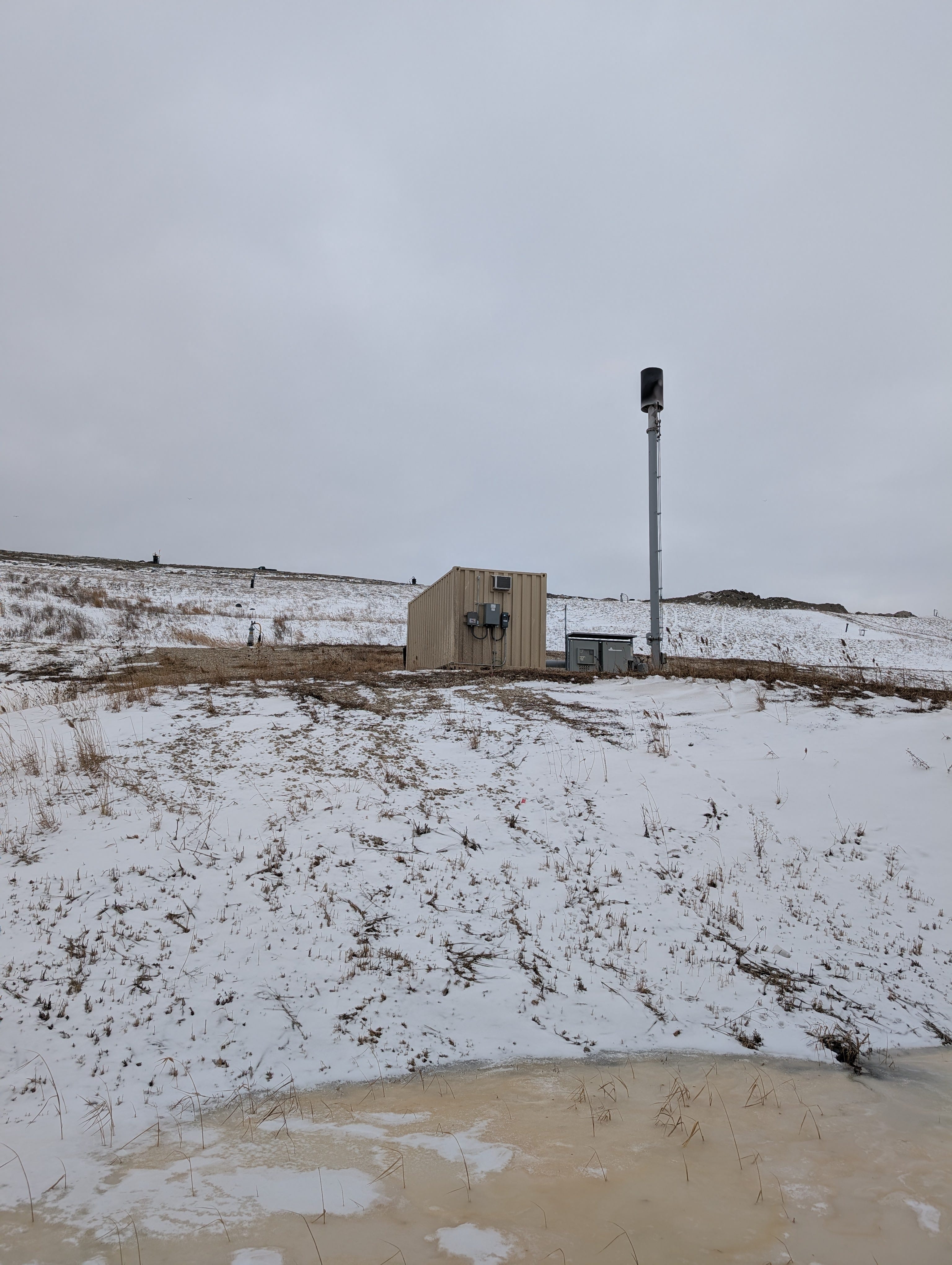
And here we have the other kicker: methane. Methane is a potent greenhouse gas that gets released as waste decomposes. Note, many other landfill sites have the ability to convert this methane to energy, but this particular site does not yet have the infrastructure to do so (though they are in talks to build it).
According to NASA, 60% of methane emissions are related to human activities, with fossil fuels and agriculture (mostly cow burps — yes, you read that right) as the leading two sources, followed by landfills in third.
Methane is especially dangerous because it is 80 times more powerful at trapping heat in the atmosphere than carbon dioxide over a 20-year period (source: Clean Air Task Force). And of course, trapping heat in the atmosphere is what contributes to global warming.
Simply put, the more trash (especially food waste) we put in landfills, the more methane we emit, and the worse it is for the future of our planet.
Four Key Takeaways to Share
There was so much to take in on that tour and so much that will sit with me for a long time after seeing it. What about you?
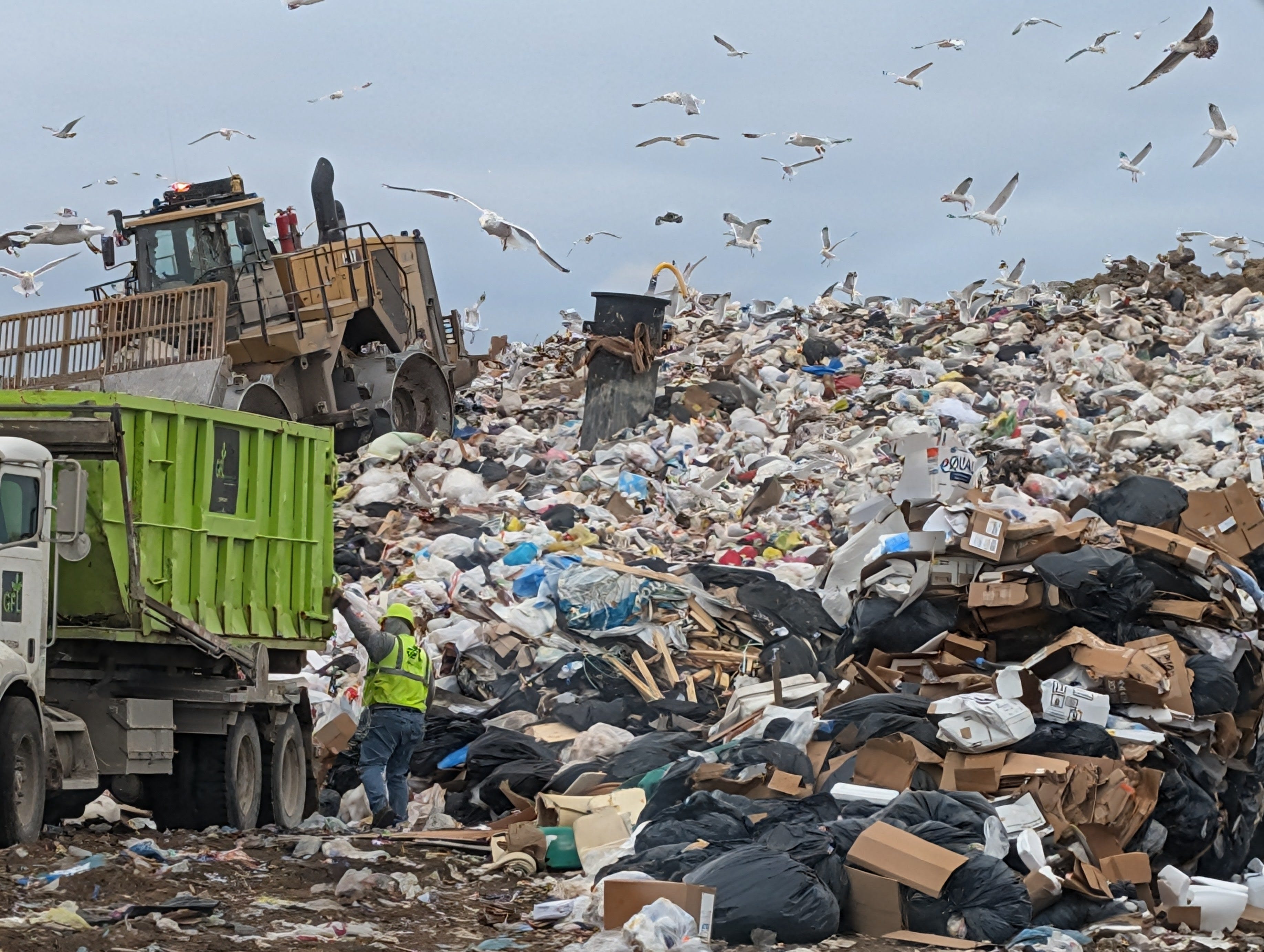
Can we also talk about how many birds there were?! It felt like an Alfred Hitchcock movie — terrifying in more ways than one.
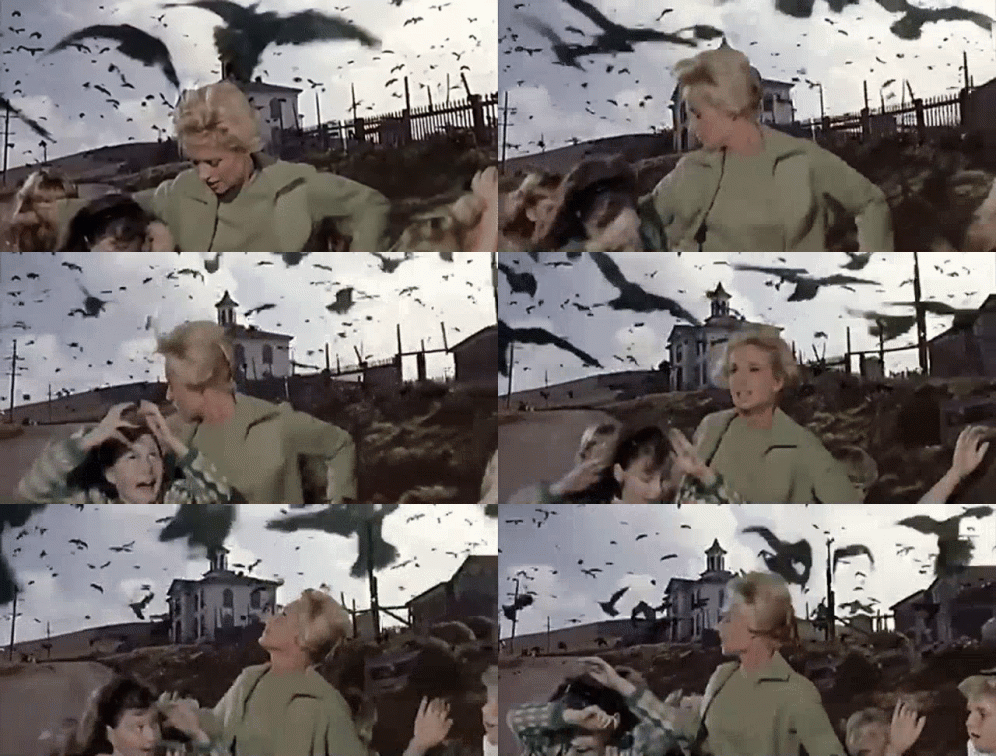
In all seriousness, it might feel like a huge mountain (literally) to climb to make any impact whatsoever on our massive trash problem. But I want to leave you with four of my biggest takeaways. And the good news is that all of them have actions you can actually control.
1. Plastic bags are an operational challenge. Again.
Plastic bags are so ingrained in our culture that Katy Perry even wrote song lyrics about them: “Do you ever feel like a plastic bag…drifting through the wind, wanting to start again?”
Well at the landfill, they very commonly do drift through the wind. In fact, the site manager said plastic bags are their “number 1 killer”. And on really windy days, they even go so far as to shut the landfill down so they can prevent all the plastic bags from flying into the neighboring town! I was honestly stunned to hear that.
If you remember my field trip to the MRF, you know that plastic bags getting caught in the machinery can easily shut the whole operation down too. So it seems like plastic bags are just bad news all around.
However, there are three things you can do to help mitigate this problem:
1️⃣ Use reusable bags instead of plastic grocery bags. I also refuse bags altogether in cases where it doesn’t make sense (looking at you, milk jug or single bottle of Tylenol that somehow still comes with a 2 ft long CVS receipt).
2️⃣ Utilize store drop offs at your local grocery store for any plastic bags or soft plastic you do have. You can also use a paid service like Ridwell or Terracycle. Either option ends up the same way — with industry partners who down-cycle them into things like decking and lawn chairs.
3️⃣ The site manager said that if you do put plastic bags in the garbage, one helpful thing is to tie them together, so they are easier for crews to grab and they’re less likely to act as parachutes catching the wind and drifting far away.
By the way, if you’re thinking, “but I put my plastic bags in the garbage bag and tie it shut!" I thought the same thing. But remember those compactors I showed you that roll over all the trash? Their sharp teeth essentially burst all the trash bags wide open, which causes anything lightweight inside to become a blow-away risk. The more you know. 🌈
2. There are items even the landfill won’t accept.
You may be tempted to think of a landfill as a catch-all for anything we don’t want anymore. But there are a few things that even landfills don’t accept, including yard waste, compost, electronics, tires, paint and batteries. The catch, of course, is that a lot of people still put these items in their garbage bags, so they end up there anyway. All of these are harmful in different ways, so they require specialty services for disposal.
In an upcoming post, I will share what to do with some of these tough-to-get-rid-of items instead. Stay tuned.
3. Food waste is the biggest problem — and biggest opportunity for impact
The main reason yard waste and compost (food waste) are harmful in landfills is because organic matter decomposes relatively quickly, causing a faster release of methane — the harmful greenhouse gas I mentioned earlier. According to the EPA, food waste accounts for a whopping 24% of all landfill waste in the US and 58% of landfill methane emissions. But that also means reducing food waste has outsized potential for impact!
You can help by putting yard waste into separate yard waste bags or bins, and by composting food waste instead of mixing these items in with your garbage. If you don’t have composting services in your area, try to minimize food waste by buying only what you need.
By the way, I know from personal experience that this one is much easier said than done and relies a lot on having the right systems in place to support it. When I lived in California, compost was collected weekly from the curb just like trash and recycling; but in Illinois (at least in the town I live now), that is not the case. I’m pretty ashamed to admit we currently don’t compost for this reason, but I’ll bet you can guess it’s at the top of my list to fix. How’s that for messy and transparent?
If you’re in Illinois too, you can go an extra step and contact your state reps about an upcoming Food Recovery and Diversion bill (SB 2852) that aims to divert food scraps from landfills. If you go to this link and scroll down, there’s a super easy form that you can fill out and send a message of support directly to your reps — without even picking up the phone.
4. Once something is in the landfill, those resources are lost forever.
There were so many items I saw in the landfill that could have been recycled or reused. For example, look at this fresh pile of perfectly good cardboard below — all gone to waste.
Think about the millions of pounds of perfectly good clothing, food, metals, lumber, and so many other resources that just get tossed without ever utilizing their full potential.
To illustrate this, A 2024 report by the Michigan Sustainable Business Forum included a chart that breaks down the state’s waste by material (Note: MSW = municipal solid waste). This is Michigan data, but let’s safely assume it’s fairly representative of other states.
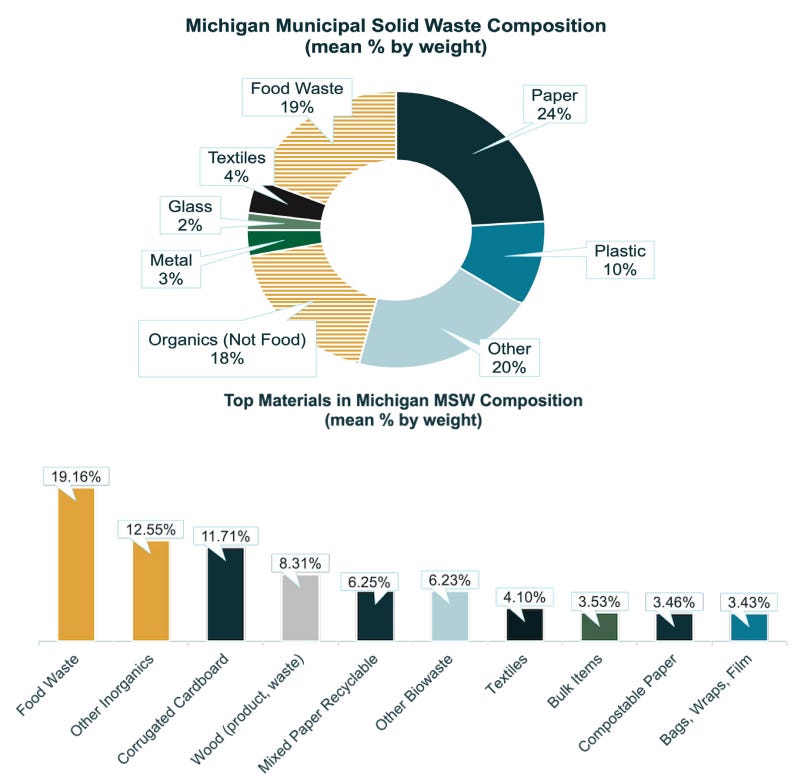
Look how much of that could have been diverted! 11% cardboard that could have been recycled?! Holy smokes. 19% food waste that could have been composted? Textiles that could have gone in a Trashie or Retold bag? On it goes.
But here’s the really cool/crazy part — they also documented the lost value of these resources.
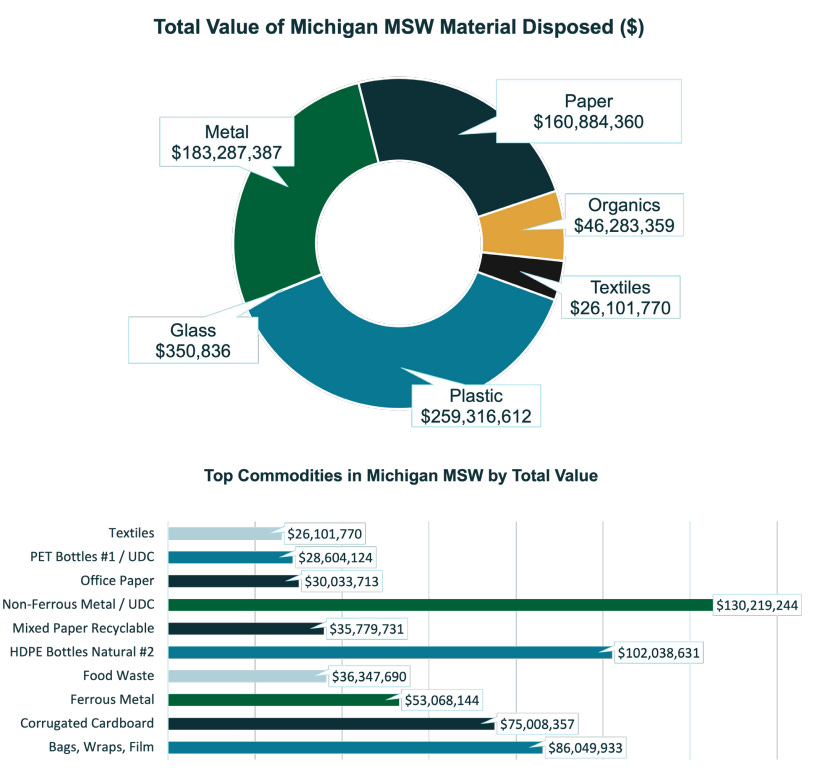
There is a LOT of economic potential here that will never be realized because these things are now buried forever.
Not only is this disappointing from a wasted resource standpoint, but it’s also frustrating from a space standpoint. Putting things that could otherwise be recovered, recycled or reused in landfill takes up valuable space and fills it faster than it otherwise would. The Zion Landfill only has about 12-13 years of life left in it before needing to expand the site into neighboring areas. According to a 2023 Environment America article, “seven states are projected to run out of landfill space in the next five years, and the entire United States will run out of existing landfill space sometime in the next 60 years.”
The Bottom Line
Ultimately, the landfill should be the last resort, reserved for stuff that truly doesn’t belong anywhere else. Even “The Rejects” (those holey socks and ratty underwear) and snack wrappers have a better place besides the landfill!
It reminds me of a quote I recently discovered from Alex Steffen, a climate futurist:
“There is no such thing as garbage, just useful stuff in the wrong place”
The next time you go to throw something “away”, remember what “away” actually looks like. Consider whether that thing you’re tossing is actually at the end of its life (ok dirty tissues, we’ll allow you), or if you can help steward it to its next chapter.
Thanks for joining me on this tour (and this learning journey).
Until next time,
Jenny